
Honda's HondaTrue Certified warranty covers eligible engine, transmission and drivetrain repairs, plus covered non-powertrain components under separate terms. Powertrain protection runs for 7 years or 100,000 total vehicle miles, whichever comes first, measured from the original in-service date. Routine maintenance, normal wear and damage are not blanket-covered, and the exact protection depends on the vehicle's certification program and warranty booklet—not simply a dealer's use of the word certified.
- What does Honda certified pre owned warranty cover? HondaTrue Certified covers eligible powertrain repairs and listed non-powertrain components.
- HondaTrue Certified powertrain coverage lasts 7 years or 100,000 total vehicle miles, whichever comes first.
- Normal wear, routine maintenance and accident damage are not covered defects.
- Before buying in 2026, confirm the certification program, original in-service date and written coverage terms.
What does Honda's certified pre-owned warranty cover?
HondaTrue Certified separates powertrain coverage from non-powertrain coverage. A covered component and a covered cause of failure must both qualify; finding a part's name in a brochure does not establish that every repair involving that part is covered.
For shopping and service help, Bristol Honda is located in Bristol, Tennessee, and serves Johnson City and Kingsport. Bring the vehicle identification number, or VIN, when asking about a particular vehicle's protection.
| Coverage category | What it addresses | Main benefit | Main limitation |
|---|---|---|---|
| HondaTrue Certified powertrain | Eligible engine, transmission and drivetrain components | Protection for covered major mechanical failures | Ends at the time or total-mileage limit; exclusions apply |
| HondaTrue Certified non-powertrain | Additional covered components identified in the warranty booklet | Protection beyond the powertrain | Has its own coverage period and component exclusions |
| Routine maintenance | Scheduled upkeep such as oil changes | Helps keep the vehicle maintained | Is not the same as defect-repair warranty coverage |
| Wear-item replacement | Items worn through normal use | Restores items that require periodic attention | Normal wear alone does not establish a warranty claim |
The reference documents are Honda's HondaTrue Certified program materials and the limited-warranty booklet applicable to your vehicle. For a 2026 purchase, ask for those documents alongside the certification paperwork rather than relying on a listing summary.
Why this matters
A certified used Honda can have different deadlines for different repairs. An engine-related claim and an air-conditioning claim do not automatically fall under the same coverage period.
That distinction matters whether you shop from Bristol, commute from Johnson City or drive from Kingsport for service. Know which coverage applies before you authorize a repair, and separate warranty questions from maintenance recommendations.
Certification adds defined protection. It does not turn a used vehicle into a maintenance-free vehicle or make every future repair eligible.
Powertrain coverage: 7 years or 100,000 total miles
HondaTrue Certified powertrain coverage lasts 7 years or 100,000 total vehicle miles, whichever comes first. The time clock begins with the vehicle's original in-service date—not the day you buy it used.
Powertrain coverage addresses eligible components within the engine, transmission and drivetrain. Think of it as protection for specified parts that produce and deliver power, not a promise that everything under the hood qualifies.
Best for: shoppers who want defined protection against covered major mechanical failures. Its advantage is the longer powertrain term; its limitation is that component exclusions, failure causes and existing mileage still matter.
Before comparing vehicles, ask for:
- The original in-service date recorded for the VIN.
- The current odometer reading.
- The powertrain expiration date and mileage ceiling.
- The applicable covered-component list and exclusions.
A lower-mileage vehicle does not necessarily have more calendar time remaining. Likewise, a newer in-service date does not prevent a high-mileage vehicle from reaching the mileage ceiling first.
For a 2026 comparison, record both deadlines beside each vehicle. Comparing only model years leaves out the information that determines remaining protection.
Non-powertrain coverage: 2 years or 100,000 total miles
HondaTrue Certified provides non-powertrain coverage for 2 years or 100,000 total vehicle miles, whichever comes first, with the starting point determined by the remaining original new-vehicle warranty and applicable program terms.
When the original new-vehicle limited warranty is still active, the certified non-powertrain extension follows that coverage under the program's rules. When the original coverage has expired, the certified coverage begins according to the delivery terms stated in the warranty documents.
Best for: shoppers who want coverage for eligible systems beyond the engine and transmission. The benefit is broader component protection; the limitation is that its deadline differs from the powertrain deadline.
Covered non-powertrain components can include eligible electrical, air-conditioning, steering, suspension and brake-system components. The booklet controls the actual list. A covered brake-system component, for example, is not the same thing as brake pads worn through ordinary use.
Do not read 100,000 miles as an additional mileage allowance. It is the vehicle's total odometer ceiling for this coverage, not a fresh allowance added when you purchase it.
Ask the team to put the non-powertrain start date, expiration date and mileage ceiling in writing. That makes the coverage easier to compare and easier to reference later.
What doesn't Honda's certified warranty normally cover?
Honda's certified warranty distinguishes defects from maintenance, normal wear and outside damage. A vehicle needing attention does not, by itself, mean that a warrantable failure occurred.
Routine maintenance
Oil changes, scheduled inspections and other routine maintenance are separate from warranty repairs. A maintenance benefit, if expressly included in your program documents, is a separate benefit with its own conditions—not evidence that all scheduled service is covered.
Keep service records. Receipts should identify the vehicle, date, mileage and work performed so you can document its maintenance history.
Normal wear
Brake friction material, tires, wiper blades and similar items wear during ordinary driving. Normal wear is different from a defect in a covered component.
Describe the symptom rather than deciding the cause yourself. A brake noise deserves diagnosis; the sound alone cannot establish whether the issue is ordinary wear or a covered failure.
Accidents, misuse and outside damage
Collision damage, environmental damage and failures caused by misuse are not the same as covered defects. Damage associated with improper maintenance or modifications also requires review against the warranty exclusions.
Ask for the specific reason when a claim is declined. A clear explanation should connect the diagnosed cause to the applicable warranty provision.
Separate coverage categories
Tires, emissions components and hybrid-related components can involve separate warranty documents or terms. Do not assume the certified powertrain deadline answers every coverage question. Ask which warranty applies to the particular component and VIN.
Why Honda certified warranty coverage varies
The badge alone does not tell you how much usable protection remains. These factors determine the answer:
- Certification program: Confirm the exact Honda-backed program rather than accepting certified as a complete description.
- Original in-service date: Powertrain coverage uses the vehicle's original service timeline.
- Current mileage: Total odometer mileage determines how close the vehicle is to the coverage ceiling.
- Remaining original warranty: Existing coverage affects the starting point of certified non-powertrain protection.
- Failed component: Powertrain and non-powertrain coverage have different scopes and deadlines.
- Cause of failure: A covered defect differs from wear, accident damage or a maintenance-related failure.
Mileage and time must be checked together. The warranty ends when the applicable limit arrives first, even if substantial room remains under the other limit.
How do you check coverage before buying?
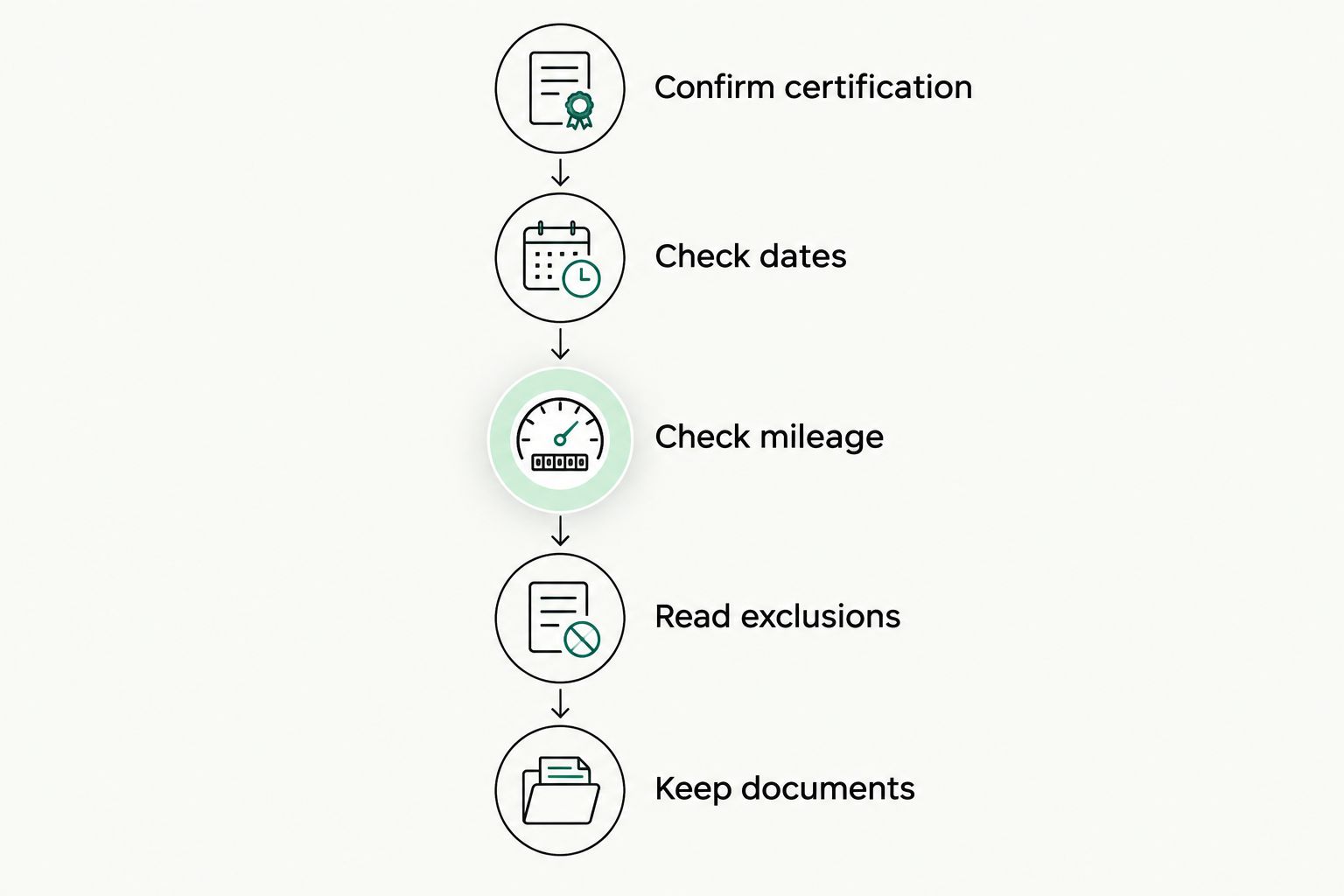
Use the same review process for every certified vehicle on your shortlist. Verify the documents before comparing the reassurance offered by the certification label.
- Confirm certification. Ask for the exact program name and the certification paperwork tied to the VIN. A dealer inspection alone does not establish enrollment in HondaTrue Certified.
- Check dates. Request the original in-service date and both coverage expiration dates. Ask how any remaining original warranty affects the certified non-powertrain term.
- Check mileage. Compare the current odometer reading with each applicable total-mileage ceiling. Consider your own driving pattern when assessing the remaining protection.
- Read exclusions. Review covered components, claim conditions and exclusions. Ask about any diagnostic or other charges before authorizing work.
- Keep documents. Save the warranty booklet, certification records, inspection paperwork and purchase documents together. Keep a copy accessible when arranging service.
For a 2026 purchase, ask for coverage information specific to the VIN rather than a general program handout alone. A useful written summary identifies the vehicle, its program and the deadlines that actually apply.
Bristol Honda is a fit for Tri-Cities drivers who want Honda vehicle sales and service at a dealership in Bristol. Ask the team to review certification paperwork while you evaluate the vehicle, not after you have made your decision.
What should you do when your certified Honda needs repair?
Start with the symptom and your warranty records. Let the service team diagnose the problem before treating it as either a covered repair or an ordinary maintenance expense.
Describe when the concern occurs: during startup, braking, acceleration or steady driving. Mention warning lights, unusual sounds and recent changes. Those details help explain the concern without guessing which part failed.
Before authorizing work, ask the service advisor:
- Which component failed, and what caused the failure?
- Which warranty is being reviewed for this repair?
- Is the vehicle within that warranty's time and mileage limits?
- What authorization is needed before repairs begin?
- Which diagnostic or repair charges require your approval if coverage does not apply?
Do not authorize a repair elsewhere on the assumption that reimbursement is automatic. Check the warranty's claim procedure first and retain any authorization you receive.
For Bristol, Johnson City and Kingsport drivers, preparing the VIN, mileage and symptom description before arranging service makes the conversation more useful. Ask Bristol Honda about the appropriate service next step and bring the maintenance records relevant to the concern.
Does Honda's certified warranty start over when you buy?
The 7-year or 100,000-mile powertrain term does not start over at your used-vehicle purchase. Its clock follows the original in-service date, and the mileage ceiling follows the vehicle's total odometer reading.
Non-powertrain coverage follows its own starting rules. Ask for both sets of dates rather than treating certification as a single new warranty clock.
Does a certified Honda warranty cover brakes and batteries?
The 2-year or 100,000-mile non-powertrain term is not blanket coverage for every brake or battery concern. A covered brake-system defect differs from worn pads, and different battery types can have different warranty treatment.
Have the failed component and cause identified. For a hybrid, specify whether the concern involves the starting battery or high-voltage battery before asking which warranty applies.
Is a certified Honda warranty the same as a service contract?
HondaTrue Certified's 7-year or 100,000-mile powertrain warranty is certification coverage, not a substitute name for an optional service contract. A separately offered contract has its own covered components, exclusions and claim procedures.
Compare documents side by side. Ask where coverage overlaps, what additional protection exists and whether the agreements end on different dates.
FAQ
What does Honda certified pre owned warranty cover?
HondaTrue Certified covers eligible powertrain repairs and additional covered non-powertrain components under separate terms. Routine maintenance, normal wear and outside damage are not blanket-covered; the applicable warranty booklet controls eligibility.
How long does HondaTrue Certified powertrain coverage last?
HondaTrue Certified powertrain coverage lasts 7 years or 100,000 total vehicle miles, whichever comes first. The time period begins at the original in-service date, not your certified used-vehicle purchase date.
How long does HondaTrue Certified non-powertrain coverage last?
HondaTrue Certified non-powertrain coverage provides 2 years or 100,000 total vehicle miles, whichever comes first. Its starting point depends on remaining original new-vehicle warranty coverage and the applicable program terms.
Does a certified Honda warranty cover oil changes?
Routine oil changes are maintenance, not defect-repair warranty work. Any separately included maintenance benefit has its own written conditions and should be checked independently.
Does Honda certified coverage include every electrical problem?
Honda certified coverage does not automatically include every electrical problem. The failed component, cause, applicable coverage period and exclusions determine eligibility.
Can I assume a repair is covered before the vehicle is inspected?
You cannot establish warranty eligibility from a symptom alone. Ask the service team to diagnose the concern and explain coverage and authorization requirements before repairs proceed.
What should I ask for before buying a certified Honda?
Ask for the exact certification program, VIN-specific coverage dates, current mileage, warranty booklet and certification paperwork. Review both powertrain and non-powertrain limits before committing.
One last thing
The most useful warranty comparison is remaining coverage, not the largest number in the brochure. A vehicle with fewer miles can still reach its calendar deadline sooner than another vehicle.
Before signing in 2026, write down the powertrain expiration date, non-powertrain expiration date and mileage ceilings. Keep that summary with the actual warranty documents. Whether you travel from Bristol, Johnson City or Kingsport, ask Bristol Honda to explain any difference between the summary and the booklet before you commit.