
Before you test-drive a used car in Bristol, TN, match its identity to the paperwork, review its history and maintenance records, and inspect the tires, fluids, controls and warning lights. A clean vehicle-history report does not replace a mechanical inspection; unresolved safety issues belong in the service bay, not on your test-drive route.
- Searching used cars Bristol TN? Check vehicle history, maintenance records and safety items before driving.
- Bristol Honda serves Honda shoppers and service customers from Bristol, Johnson City and Kingsport at its Bristol location.
- A vehicle-history report documents reported events; an independent inspection checks the car’s present condition.
- Stop the test drive if braking, steering, tires or warning lights raise a safety concern.
Why this matters
A test drive tells you how a car feels. It does not tell you whether the title matches the vehicle, whether scheduled maintenance was completed, or what an unexplained warning light means. Check those items first so you can spend the drive evaluating the car rather than discovering preventable problems.
Bristol Honda suits Tri-Cities drivers who want Honda buying help and vehicle service at a dealership in Bristol. Bristol Honda is located in Bristol, Tennessee, and serves Johnson City and Kingsport; plan your visit around that location rather than assuming a separate dealership in either city.
Use this 2026 checklist whether you are replacing a daily driver or adding a second vehicle. Keep your shopping questions and service questions together: the car’s maintenance needs matter just as much as its equipment.
Used cars in Bristol, TN: what should you check before a test drive?
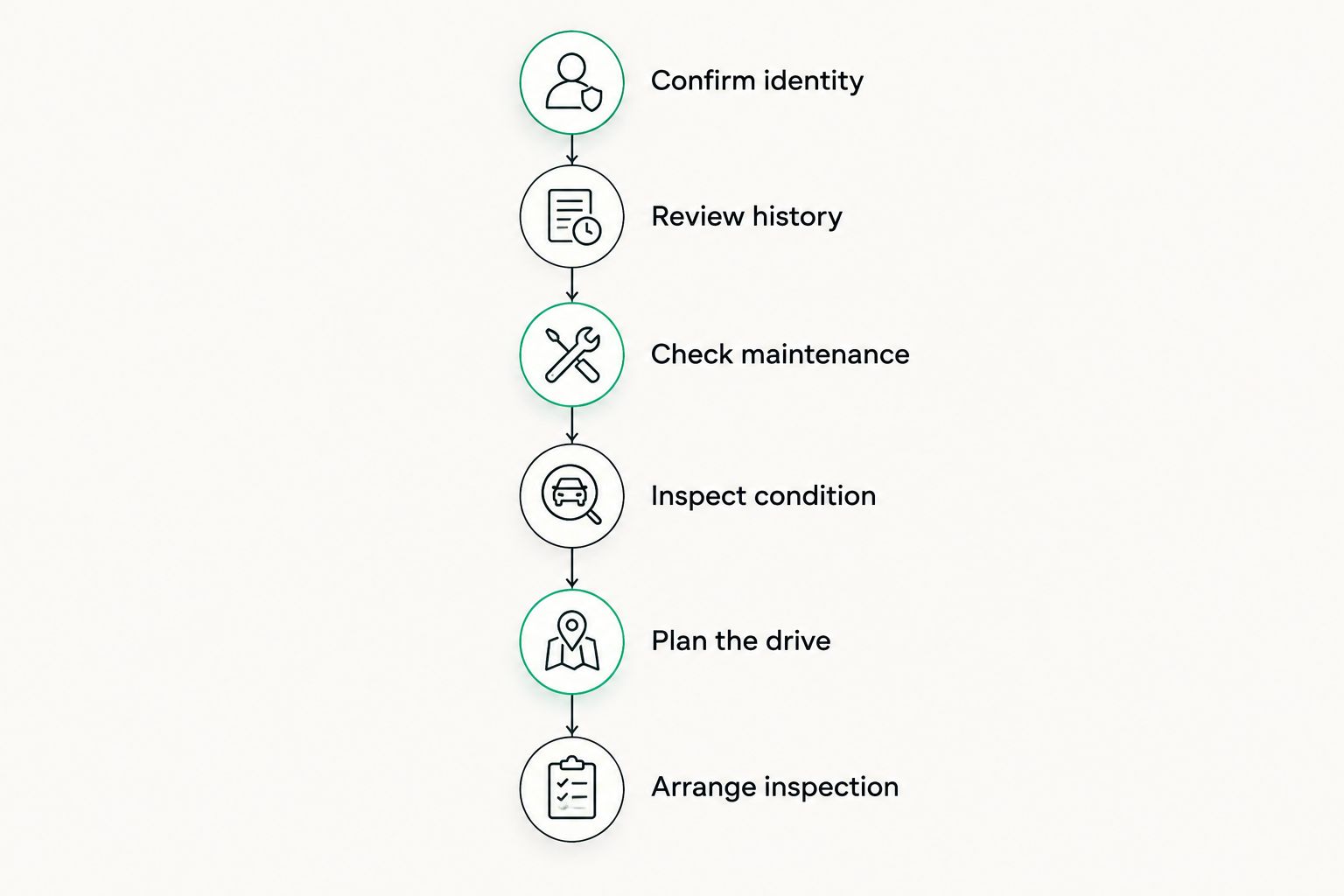
Start with the paperwork, then work from the outside of the car to the cabin and engine compartment. Finish by agreeing on a route and deciding whether the car is safe to drive. The sequence below keeps cosmetic details from distracting you from ownership or mechanical concerns.
- Confirm identity. Match the vehicle identification number on the car to the title information, history report and sale documents.
- Review history. Look for reported collisions, title brands, mileage discrepancies and open safety recalls.
- Check maintenance. Compare dated service records with the owner’s manual and the vehicle’s maintenance reminders.
- Inspect condition. Examine the body, tires, cabin controls and accessible fluid checks before starting the engine.
- Plan the drive. Ask permission for a route that includes ordinary stopping, turning and steady-speed driving.
- Arrange inspection. Set aside time for a qualified mechanic to evaluate concerns before you commit to buying.
For a 2026 purchase, write down what you verified and what still needs an answer. A specific note such as uneven front-tire wear is more useful than a general impression that the car needs attention.
Check the VIN, title information and vehicle history
Modern vehicles use a 17-character VIN. Compare the dashboard VIN with the documents you receive, and ask about any mismatch before proceeding. Also compare the displayed mileage with dated entries in the history and service records.
Read the report beyond its summary. A reported collision deserves questions about repairs, while a title brand deserves a clear explanation of what it means for that particular vehicle. Do not assume an unreported event never happened; reporting coverage is not the same as a physical inspection.
Ask how you can check for open recalls using the VIN. A recall lookup and a maintenance record answer different questions: one concerns an identified safety campaign, while the other concerns work performed on the car.
Keep your documents together when comparing vehicles. That makes it easier to distinguish a genuinely documented service history from a seller’s general statement that the car was maintained.
Separate certified status from the car’s actual condition
A certified pre-owned designation is a program status, not a substitute for reading the paperwork. Ask which certification program applies, what inspection documentation accompanies the car, and which written coverage terms apply to that specific vehicle.
For a used-car purchase in 2026, compare the documents rather than assuming every certification label means the same thing. A standard used vehicle also deserves a careful inspection and a written explanation of any coverage offered.
| Purchase category | Best for | Useful starting point | Limitation to check |
|---|---|---|---|
| Certified pre-owned Honda | Shoppers who want a documented Honda certification program | Review the applicable program and vehicle-specific paperwork | Certification does not eliminate the need to inspect current condition |
| Standard pre-owned vehicle | Shoppers comparing individual vehicles on condition and suitability | Review history, service records and an inspection | Do not assume certification or warranty coverage applies |
Choose on documented condition, fit and written terms—not on the label alone. If the seller cannot explain a claim clearly, leave it unresolved rather than treating it as a benefit.
Inspect the body, glass and all four tires
Walk around the car in good light. Look for inconsistent panel gaps, damaged glass, rust, loose trim and paint differences that deserve an explanation. These observations are questions to investigate, not proof of a specific accident or repair.
Check all four road tires, not just the easiest one to see. Look for sidewall damage, visible cords and uneven tread wear, then compare tire sizes with the vehicle’s specified fitment. Ask a technician to assess concerns rather than assuming an alignment alone will fix them.
The National Highway Traffic Safety Administration’s tire guidance identifies 2/32 inch of remaining tread as the replacement threshold. Do not treat that threshold as a target for buying a car; tread depth is only one part of tire condition, alongside damage, age and suitability.
Inspect the spare or tire-repair equipment if the vehicle is equipped with it. Ask what belongs with that exact vehicle instead of assuming every used car includes a spare wheel.
Review maintenance before you judge the engine
Maintenance records help you identify the next service questions. Look for dates, mileage and descriptions of completed work, not simply a stack of receipts. Match those records to the requirements for the exact vehicle and engine.
Ask about oil service, brake work, tire replacement and any applicable transmission-fluid or coolant service. Do not apply one model’s schedule to another. For a Honda, use the applicable owner’s manual and Maintenance Minder guidance rather than a generic interval supplied from memory.
A missing receipt is not proof that service was skipped, but it does leave work unverified. Ask whether the work can be documented or whether a technician should evaluate the relevant system before purchase.
Turn every maintenance gap into a specific question. For example, ask what supports a claim that the transmission was serviced, rather than accepting that the vehicle was recently checked over.
Check fluids and warning lights safely
Ask for the engine to be off and cool for checks that require it. Follow the owner’s manual for accessible fluid checks, and never remove a hot cooling-system cap. If you are unfamiliar with the procedure, let a technician handle it.
Look for visible leakage around the parked car and accessible engine-compartment areas. Fluid color alone does not establish condition or diagnose a problem. A leak needs an explanation of its source and a repair assessment.
Watch the dashboard during startup. Some lights illuminate as part of the startup check; lights that remain on require interpretation using the owner’s manual and, when appropriate, diagnostic testing.
Do not accept a warning-light reset as proof of a repair. Ask what caused the warning, what work addressed it and what documentation supports that answer. A flashing malfunction indicator or a brake-related warning warrants stopping and seeking qualified guidance rather than continuing your evaluation.
Test cabin controls before leaving the lot
Adjust the seat, steering wheel and mirrors to your driving position. Confirm that you can see clearly, reach the pedals comfortably and fasten the seat belt correctly. Have regular passengers check their seating position too.
Try the headlights, turn signals, wipers, windows, locks and climate controls while parked. Check that the windshield clears properly and that controls respond as expected. A cabin feature that fails is still a repair question, even when it does not affect the engine.
If phone connectivity or a driver-assistance feature matters to you, verify it on the exact car. Equipment varies by model year and trim, so a badge or an advertisement is not enough to establish which functions are present.
For your 2026 comparison, separate essential needs from preferences. Visibility, seat-belt function and working safety equipment belong ahead of convenience features.
Why inspection priorities vary
The same checklist applies across Bristol, Johnson City and Kingsport, but the emphasis changes with the individual vehicle and how you intend to use it.
- Vehicle age and mileage: Compare recorded maintenance with the requirements applicable to that car.
- Reported repairs: Ask for supporting repair documentation and inspect the affected areas.
- Tire and brake condition: Decide whether wear or damage needs professional assessment before driving.
- Equipment and powertrain: Confirm the exact features and maintenance procedures rather than borrowing assumptions from another trim.
- Your daily use: Evaluate seating, cargo access, visibility and driving comfort against your actual trips.
Tell the service adviser about observations, not a diagnosis you cannot verify. Describing a vibration under braking gives a technician a clearer starting point than declaring that the car needs a particular part.
What should you pay attention to during the test drive?
Pay attention to steering, braking, acceleration and visibility before convenience features. Choose a permitted route that lets you evaluate ordinary driving without aggressive maneuvers or exceeding posted limits.
Begin with gentle inputs. Notice whether the steering responds consistently, the brakes feel predictable, and the car accelerates without unexplained hesitation. Listen for noises and record when they occur—during a turn, over a bump or under braking.
Where the approved route allows, include the kinds of roads you normally use. Bristol shoppers should evaluate their Bristol trips; Johnson City and Kingsport shoppers should consider their own commutes and parking needs with equal care.
Do not test emergency systems by deliberately creating a hazardous situation. If a serious concern appears, stop safely and contact the seller rather than trying to reproduce it on a public road.
Should you arrange a pre-purchase inspection?
Arrange a pre-purchase inspection before committing when you need an independent assessment of mechanical condition. A history report describes reported events; a mechanic examines the vehicle as it exists now.
Ask the inspector to address your observations and explain the scope of the inspection. Not every inspection includes the same checks, and no inspection guarantees that a used vehicle will never need repairs.
Request findings in writing. Separate safety concerns, needed repairs and routine maintenance so you can make a clear decision. If an important system cannot be assessed, ask what additional testing would answer the question.
How should you plan service after buying a used car?
Plan service from verified records and the vehicle’s actual maintenance requirements. Carry unresolved questions into the service appointment rather than assuming that purchase preparation covered every maintenance item.
Bristol Honda provides vehicle service and parts in Bristol for drivers from Bristol, Johnson City and Kingsport. Ask the team about Honda-specific maintenance, technician qualifications and the appropriate inspection for your vehicle; describe any symptoms and bring the records you have.
For a 2026 purchase, keep the sale documents, inspection findings and service history together. That gives your next technician a useful starting point and helps you track what has actually been completed.
Plan your next dealership visit
Review buying and service information for a visit to the dealership in Bristol.
FAQ
What should I check first when shopping for used cars in Bristol, TN?
First, match the vehicle’s VIN to its paperwork and review its history and maintenance records. Then inspect the tires, warning lights and basic controls before taking a test drive.
Is a clean vehicle-history report enough to buy a used car?
No, a clean vehicle-history report does not establish the car’s current mechanical condition. Combine the report with service records, a physical inspection and a test drive.
Should I test-drive a used car with a warning light on?
Identify the warning before deciding whether to drive. Brake-related warnings, a flashing malfunction indicator or other serious symptoms require qualified guidance rather than an exploratory test drive.
Does certified pre-owned mean I can skip an inspection?
No, certified pre-owned status does not replace checking the specific car’s condition and paperwork. Ask which program applies and review its inspection documentation and written terms.
How much tread should I check on used-car tires?
The tire replacement threshold in NHTSA guidance is 2/32 inch of remaining tread. Inspect all four road tires for uneven wear and damage as well; tread depth alone does not establish tire safety.
Can Bristol Honda help drivers from Johnson City and Kingsport?
Bristol Honda serves drivers from Bristol, Johnson City and Kingsport with vehicle sales, financing, service and parts. The dealership is located in Bristol, Tennessee, not in Johnson City or Kingsport.
What maintenance should I schedule after buying a used Honda?
Schedule maintenance according to the exact vehicle’s records, owner’s manual and applicable Maintenance Minder guidance. Ask a qualified technician to resolve undocumented service and any findings from the pre-purchase inspection.
One last thing
Photograph the odometer and write down your observations before discussing the car. Record the conditions behind each symptom, such as a noise during a turn or vibration while braking. Clear notes turn a vague concern into a question the seller or technician can investigate.
Keep that checklist separate from your enthusiasm for the vehicle. A comfortable test drive is useful evidence, but it is not an answer to an unresolved title, safety or maintenance question.