
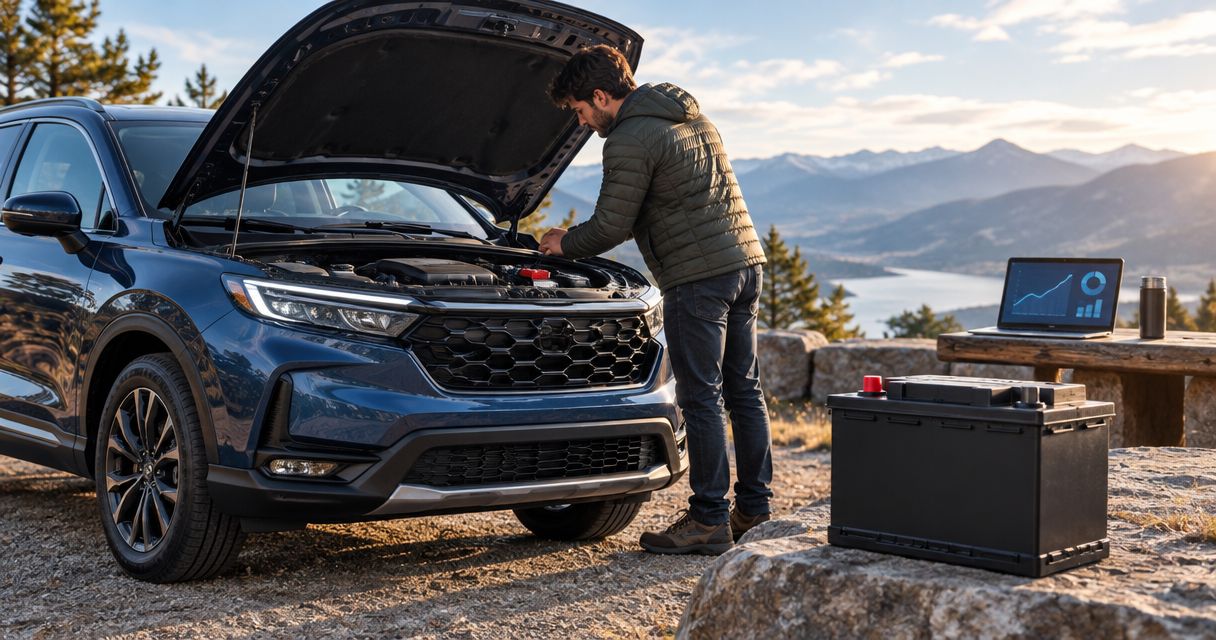
A Honda battery needs replacing when testing shows it can no longer do its job reliably—not simply when it reaches a particular birthday. For a conventional 12-volt battery, age helps you decide when to arrange testing; a hybrid’s high-voltage battery requires a separate assessment, and repeated starting trouble can also come from charging-system faults or electrical drains.
- How long does a Honda battery last? AAA gives conventional car batteries a general lifespan of 3–5 years.
- Honda 12-volt batteries and hybrid high-voltage batteries need different tests; do not apply the same replacement timeline.
- Replace a failing battery based on test results, not a successful jump-start or age alone.
- Used Honda shoppers should request battery history and inspection results before deciding whether replacement is necessary.
How long does a Honda battery last before it needs replacing?
A conventional Honda 12-volt battery generally falls within the 3–5-year service-life range AAA describes for car batteries. That is general automotive guidance, not a Honda replacement schedule or a promise about your particular battery.
For your 2026 maintenance planning, combine the battery’s installation date with its test results and recent behavior. A younger battery with an internal failure needs attention; an older battery that passes appropriate testing does not automatically need replacement that day.
Bristol Honda is located in Bristol and serves drivers from Johnson City and Kingsport. Bring your starting symptoms and battery history when discussing service, rather than asking for a replacement based only on the vehicle’s age.
| Battery type | Main job | Lifespan guidance | Best next step | Important limitation |
|---|---|---|---|---|
| Conventional 12-volt battery | Powers vehicle electronics and supports starting, depending on the powertrain | General car-battery guidance is 3–5 years | Request a battery and charging-system assessment | Age alone does not establish battery health |
| Hybrid high-voltage battery | Stores energy used by the hybrid drive system | Do not apply the conventional battery timeline | Follow model-specific diagnostic guidance | A conventional battery test does not evaluate this battery |
The distinction matters before you approve any work. A hybrid can have a low-voltage battery problem without having a failed high-voltage battery.
Why this matters
A no-start problem interrupts your day whether you are leaving home in Bristol, heading to work in Johnson City, or running errands in Kingsport. Replacing the wrong component also leaves the actual fault unresolved.
The useful question is not just how old the battery is, but whether it holds charge and performs correctly under an appropriate test. For a used-car shopper, the same question separates a documented maintenance item from an assumption based on a clean engine compartment.
For 2026 shopping and ownership decisions, keep battery age, battery condition, and vehicle age separate. They describe different things.
Conventional 12-volt battery: use 3–5 years as a guide
A conventional battery gradually loses its ability to store and deliver energy. Temperature exposure, charging conditions, and use patterns affect that process, so a calendar cannot tell you the exact day it will fail.
AAA recommends battery testing once a car battery reaches 3 years of age. Treat that as a reason to establish its condition, not as an instruction to replace every battery at that age.
Ask for an explanation of the result in everyday terms. You want to know whether the battery passed, needs charging and retesting, or failed—and whether the charging system or connections require further investigation.
A battery that has discharged after a light was left on presents a different situation from one that repeatedly loses charge without an obvious cause. Describe what happened before the problem, including recent jump-starts, long parking periods, or electrical work.
Best for: owners deciding whether to keep using an existing battery. Testing supports that decision, but no test guarantees the battery’s future lifespan.
Hybrid high-voltage battery: use model-specific diagnosis
A Honda hybrid’s high-voltage battery is not interchangeable with its low-voltage battery. The batteries serve different purposes, and neither battery’s condition can be established from the other battery’s test result.
If you are shopping for a hybrid in 2026, ask which battery an inspection report discusses. A statement that the battery passed is incomplete unless the report identifies the system and the assessment performed.
Request an explanation of any hybrid-system warnings, diagnostic findings, and applicable coverage documents. Coverage terms and battery condition are separate subjects: a warranty document does not establish present health, and a warning message does not by itself identify a failed component.
Best for: hybrid owners and shoppers clarifying a warning or inspection finding. Model-specific diagnosis is useful; applying a conventional battery’s expected lifespan is not.
Do not open, disconnect, or attempt repairs on high-voltage components. Leave that work to appropriately trained technicians.
Why Honda battery life varies
The same battery age can produce different test results in different vehicles. These established battery-life factors explain why an installation date is only part of the picture:
- Heat exposure: Heat accelerates chemical aging inside a conventional battery. Cold weather can reveal weakness that developed earlier.
- Short trips: Repeated short drives can leave insufficient opportunity to restore energy used during starting, particularly when electrical demand is high.
- Extended parking: Vehicle electronics continue using some energy while parked. Long periods without adequate charging can leave a battery discharged.
- Electrical drain: An abnormal draw, including a fault or improperly installed accessory, can discharge an otherwise serviceable battery.
- Charging and connections: Charging-system faults, loose connections, and corrosion can interfere with reliable operation and imitate battery failure.
- Battery suitability: The replacement must meet the vehicle’s specified battery requirements. Physical fit alone is not enough.
These factors also matter during a used-car inspection. Ask about the vehicle’s recent use rather than assuming that low mileage means the battery has had an easy life.
What should you do when starting becomes unreliable?
Diagnose the starting problem before authorizing a battery replacement. Slow cranking, clicking, or an intermittent no-start gives a technician useful clues, but those symptoms do not prove the battery is the only cause.
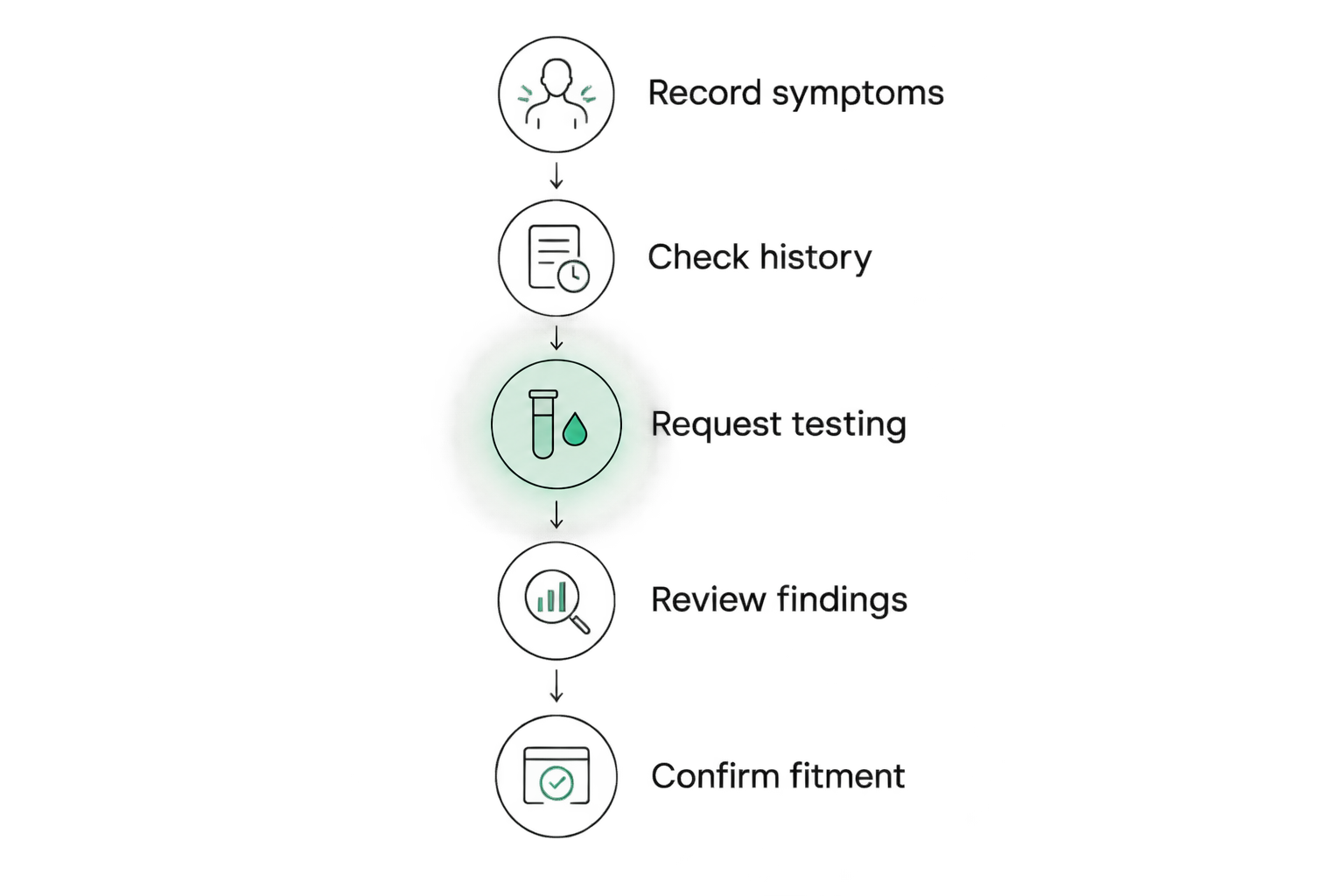
Use this sequence when arranging an assessment:
- Record symptoms. Note whether the engine cranks slowly, clicks, starts after a jump, or shows a warning. Explain whether the trouble follows overnight parking or occurs after driving.
- Check history. Bring any battery receipt, installation date, prior test report, and recent repair information. Tell the technician about accessories connected while parked.
- Request testing. Ask for an appropriate battery assessment and checks of charging performance and connections. A discharged battery can require charging before its condition is judged accurately.
- Review findings. Ask what failed, what passed, and whether further diagnosis is needed. Request written findings rather than relying on a verbal description alone.
- Confirm fitment. If replacement is needed, confirm the specified battery type and rating for the exact vehicle. Ask whether any model-specific procedures follow installation.
A successful jump-start is useful information, not a diagnosis. If the battery repeatedly goes flat, replacing it without investigating the cause risks another interruption.
For more symptom-specific guidance, review Honda battery replacement signs that call for testing. If the battery is swollen, leaking, or producing an unusual odor, stop handling it and seek professional assistance.
What should you check before buying a used Honda?
A used Honda’s model year does not tell you when its current battery was installed. During your 2026 search, assess the battery as a maintenance item alongside the vehicle’s broader condition and service history.
Start with documents. A dated replacement receipt establishes more than a seller’s recollection, while an inspection report should identify which battery was tested and what the result means.
Ask for a start before the test drive
Ask whether the vehicle has already been running or connected to a charger. That context helps you interpret the starting demonstration, although a normal start still does not replace testing.
Do not accept a jump-start as proof that the issue is resolved. Ask what caused the discharge and whether the vehicle received further checks afterward.
Read the inspection, not just the summary
Look for a clear battery assessment rather than a general statement that everything looks good. If the result calls for charging and retesting, ask whether that follow-up happened.
For a hybrid, separate the low-voltage battery assessment from any high-voltage system evaluation. Neither should be represented as a substitute for the other.
Keep the whole vehicle in perspective
A new battery does not establish the condition of the engine, transmission, brakes, tires, or hybrid system. Equally, an aging conventional battery does not by itself make an otherwise suitable vehicle a poor choice.
Best for: used Honda shoppers comparing maintenance needs. A documented inspection supports the decision; a battery replacement alone does not settle it.
How should battery care affect your next Honda purchase?
Choose a vehicle around your driving needs, then understand its maintenance requirements. Do not choose between a gasoline Honda and a Honda hybrid solely because you have heard a general battery-life claim.
For a gasoline vehicle, ask about the specified conventional battery and any relevant replacement procedures. For a hybrid, ask the team to explain both battery systems and the documents that apply to the exact vehicle.
Bristol Honda is best suited to Tri-Cities drivers seeking Honda sales and service at a dealership in Bristol. The team serves Bristol, Johnson City, and Kingsport; the dealership is not located in all three cities.
When comparing vehicles in 2026, use these questions:
- What battery-related work appears in the available service records?
- Which battery systems have been assessed, and what do the findings say?
- Are there unresolved starting concerns or warning messages?
- What does the owner’s manual require for this exact model?
- Which coverage documents apply to this vehicle and its replacement parts?
This keeps the conversation practical without turning a general lifespan estimate into a repair promise.
Can a Honda battery last longer than 5 years?
More than 5 years is possible for a conventional battery, but age does not prove reliability. Keep arranging appropriate tests and respond to changing starting behavior rather than treating extra service life as a guarantee.
If you are buying a vehicle with an older battery, ask for current findings. An installation date explains its age, not its remaining life.
Should you replace a Honda battery before winter?
A 3-year-old battery merits testing under AAA’s guidance, not automatic winter replacement. Cold conditions reduce a conventional battery’s ability to deliver power while increasing starting demands, making existing weakness more noticeable.
Before seasonal travel, address repeated slow starts, recent discharges, and unresolved test findings. Drivers in Bristol, Johnson City, and Kingsport should use the same condition-based approach.
FAQ
How long does a Honda battery usually last?
A conventional Honda 12-volt battery generally falls within AAA’s 3–5-year guidance for car batteries. That is a general service-life range, not a Honda replacement interval; testing determines whether your battery needs attention.
When should I start having my Honda battery tested?
AAA recommends testing a conventional car battery once it reaches 3 years of age. Arrange an assessment earlier if you notice starting trouble, repeated discharges, or other concerns.
Does a Honda hybrid battery last the same amount of time?
A Honda hybrid’s high-voltage battery should not be judged using a conventional battery’s lifespan. Identify which battery is involved and follow the exact model’s diagnostic guidance.
Does needing a jump-start mean I need a new battery?
Needing a jump-start does not automatically mean you need a replacement battery. Discharge, poor connections, electrical drains, or charging-system problems also require investigation.
Can I tell whether a Honda battery is good from its voltage?
A voltage reading alone does not establish a battery’s ability to perform reliably. An appropriate battery assessment considers its condition and performance, not just the displayed voltage.
What should I ask about the battery before buying a used Honda?
Ask for the installation date, available replacement records, and current inspection findings. For a hybrid, confirm whether each finding concerns the low-voltage battery or the high-voltage system.
Where is Bristol Honda located for sales and service?
Bristol Honda is located in Bristol, Tennessee, and serves drivers from Johnson City and Kingsport. Contact the dealership to discuss your vehicle-shopping or service needs before visiting.
One last thing
A replacement battery does not fix an electrical drain. If the same no-start returns, bring the previous test results and describe exactly when the trouble happens instead of assuming another battery is the answer.
For your next service discussion in 2026, save the battery receipt and test report with your vehicle records. Those documents help both you and a future buyer distinguish battery age from documented condition.