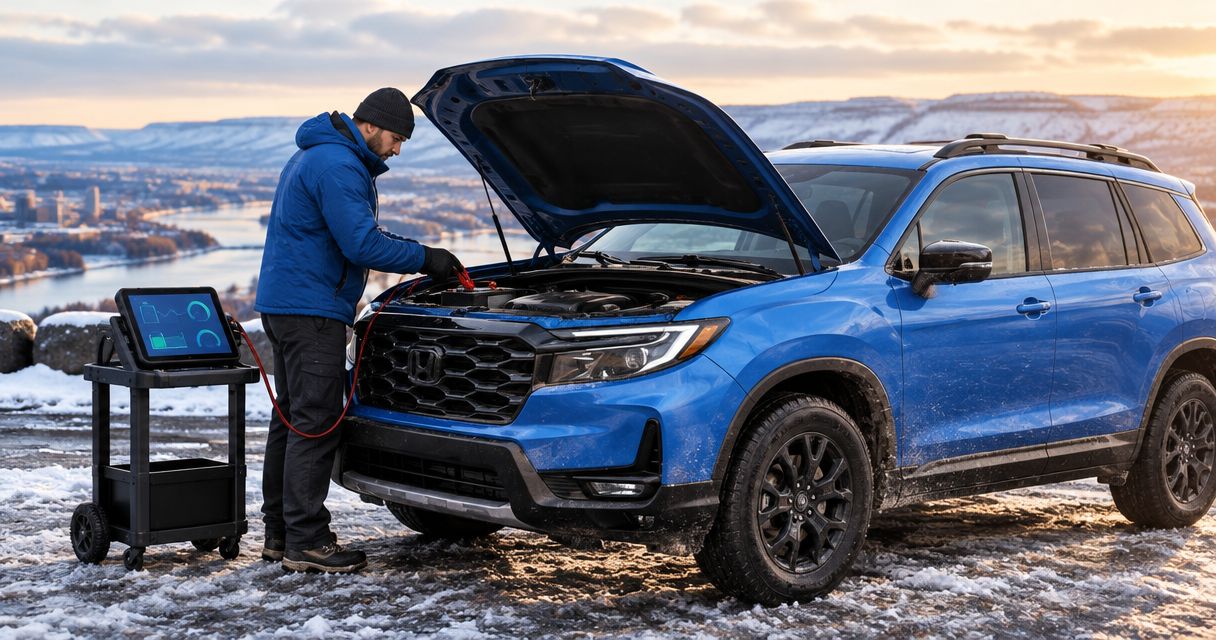
For Tri-Cities drivers, car battery testing before winter is a check of battery condition and starting performance aimed at preventing cold-weather no-starts. Whether you drive from Bristol, Johnson City or Kingsport, this guide explains what to inspect yourself, what to ask a technician and what to check before buying another Honda.
- Start car battery testing before winter with an inspection; use a battery test to decide whether replacement is necessary.
- Bristol Honda serves Tri-Cities drivers seeking Honda vehicle-shopping help and service in Bristol.
- A resting-voltage reading shows charge level, not the battery's ability to deliver starting power.
- When shopping for a used Honda, request battery-test findings alongside the vehicle's maintenance records.
Why battery testing matters for Tri-Cities drivers
Cold weather reduces a lead-acid battery's ability to supply current while making an engine harder to crank. A battery that starts your car during mild weather does not necessarily have enough reserve for a colder morning.
For your 2026 winter preparation, treat battery condition as a maintenance question and a shopping question. Your current Honda needs a dependable electrical supply; a used Honda you are considering deserves the same scrutiny before you buy it.
Bristol Honda is best for Tri-Cities drivers seeking Honda buying help and service at a dealership in Bristol. Bristol Honda serves Johnson City and Kingsport from its Bristol location, rather than operating dealerships in those cities.
Your decision should follow the evidence: inspect, test and then choose whether to keep, recharge, investigate or replace the battery. A slow start alone does not identify which action is right.
How to prepare your Honda battery before winter
1. Record how your Honda starts and gets used
Begin with a simple observation log before arranging service. Note whether starting trouble happens after an overnight stop, after several days parked or immediately after driving. Those situations give a technician different clues.
For Bristol drivers, record your actual errands and parking routine. Johnson City drivers should do the same with their regular journeys, and Kingsport drivers should describe their own commute rather than relying on a general description of local driving.
Frequent short trips can leave a battery insufficiently recharged, particularly when electrical accessories are in use. Long periods parked also matter. Neither pattern proves that the battery needs replacement.
When shopping, apply the same questions to the Honda you are considering. A vehicle's recent storage and driving history provides context, but it does not replace a test.
- Record slow cranking, clicking or failure to start.
- Note recent jump-starts and periods parked.
- Describe short trips and accessory use.
- Gather service records and any previous battery-test report.
2. Inspect the battery without disturbing it
Your first hands-on check should be visual. Follow the owner's manual to identify the battery and any designated inspection or jump-start points; do not assume every Honda places them in the same location.
Look for a damaged case, leakage, loose-looking mounting hardware or corrosion around accessible terminals. Do not attempt to charge or jump-start a battery that is cracked, leaking, swollen or suspected to be frozen. Arrange professional assessment instead.
Keep metal tools and jewelry away from battery terminals. Do not disconnect cables simply to get a better look: battery disconnection can affect vehicle settings and procedures, depending on the model.
If you are inspecting a used Honda before purchase, ask the seller to explain visible corrosion or recent battery work. A clean battery case is useful to see, but cleanliness alone says nothing about remaining starting capability.
- Inspect only safely accessible areas.
- Look for cracks, swelling, leakage and corrosion.
- Check whether the battery appears securely mounted.
- Leave damaged batteries and cable repairs to a technician.
3. Separate charge level from battery health
A conventional automotive lead-acid battery is described as a 12-volt battery. A fully charged example commonly reads about 12.6 volts at rest, but temperature, battery construction and recent charging affect how a reading should be interpreted.
A multimeter can help an experienced owner check voltage using the vehicle's instructions. It cannot, by itself, establish that the battery will deliver enough current when needed. Recent driving or charging can also leave a surface charge that affects the reading.
For your 2026 prewinter check, ask Bristol Honda about battery testing and the appropriate next step for your Honda. Confirm what the appointment includes rather than assuming a voltage check and a starting-performance assessment are interchangeable.
When buying a used vehicle, request the test findings rather than accepting a statement that the battery was recently charged. Charging addresses charge level; it does not establish overall health.
- Follow the owner's manual before using test equipment.
- Record voltage without treating it as a pass-or-fail verdict.
- Tell the technician about recent charging or jump-starting.
- Ask whether charging and retesting are needed.
4. Request a test matched to the battery
Professional battery testing must account for the battery's type and rating. Ask the technician to identify the installed battery and explain whether the tester settings match it. A result is only useful when the test fits the battery.
Cold-cranking amps, or CCA, describe a battery's standardized cold-starting capability. The rating uses a test at 0°F lasting 30 seconds; it is not a promise that your vehicle will start under every winter condition.
Your Honda's required specification matters more than choosing a battery with the largest number on its label. Battery construction, physical fit and terminal arrangement also belong in the replacement decision.
For a vehicle purchase, ask whether the reported result belongs to the battery currently installed. Keep the findings with your other inspection documents so the buying decision rests on identifiable information.
- Confirm the battery type and labeled rating.
- Request an explanation of the test result.
- Ask whether cable or connection condition affected testing.
- Keep a copy of the findings for your records.
5. Investigate repeated discharge before replacing parts
A failed battery test can support replacement. A battery that repeatedly loses charge also calls for a look at why it is going flat. Loose connections, charging-system problems or an electrical draw while parked require a different response from ordinary battery deterioration.
Tell the technician about accessories you have added, including equipment that remains connected when the vehicle is off. Do not start pulling fuses or disconnecting components without an appropriate diagnostic procedure.
A new battery is not a substitute for diagnosing repeated discharge. If your Honda needs repeated jump-starts, ask what evidence separates a battery fault from a charging or electrical issue.
The same rule applies when shopping in 2026. A replacement battery is useful information, but ask why replacement was necessary and whether the original complaint was resolved.
- Describe how quickly the battery loses charge.
- List plugged-in or aftermarket electrical accessories.
- Ask whether charging-system checks are warranted.
- Request a repair explanation tied to the findings.
6. Match replacement parts to your specific Honda
Start with the owner's manual and the vehicle's identification details rather than ordering by appearance. A battery that fits into the tray is not automatically the correct replacement. Required construction and electrical specifications can differ between vehicles.
Ask the parts or service team to confirm fit using your Honda's model, model year and powertrain. If the vehicle specifies an absorbed glass mat battery, do not substitute another type without confirming the manufacturer's requirements.
Hybrid shoppers need an additional distinction: the low-voltage battery and the high-voltage propulsion battery serve different purposes. A satisfactory low-voltage test does not establish propulsion-battery health.
Bristol Honda offers service and parts support, but confirm the specific battery, installation procedure and appointment arrangements before making a trip from Bristol, Johnson City or Kingsport.
- Provide the vehicle identification number.
- Confirm battery type, fit and terminal orientation.
- Ask about model-specific installation procedures.
- Separate low-voltage concerns from hybrid-system questions.
7. Connect the findings to your ownership decision
Use the test result to decide what happens next, not to justify a decision already made. A satisfactory result supports continued use, while an instruction to charge and retest means the assessment is not finished. A replacement recommendation should come with an explanation.
For your current Honda, ask what maintenance or diagnosis remains after the battery check. Before buying another Honda, consider the battery alongside tires, brakes, maintenance records and the wider vehicle inspection.
Keep shopping and service decisions separate. A weak battery does not establish that you need another car, and a recently installed battery does not establish that a used vehicle is mechanically sound.
Your 2026 winter plan should end with a clear action and a record of the findings. That makes the next conversation easier, whether it happens at a service counter or during a vehicle purchase.
- Keep using a battery with satisfactory findings.
- Complete requested charging and retesting.
- Resolve identified connection or charging faults.
- Include battery condition in a broader purchase inspection.
Compare your battery-checking options
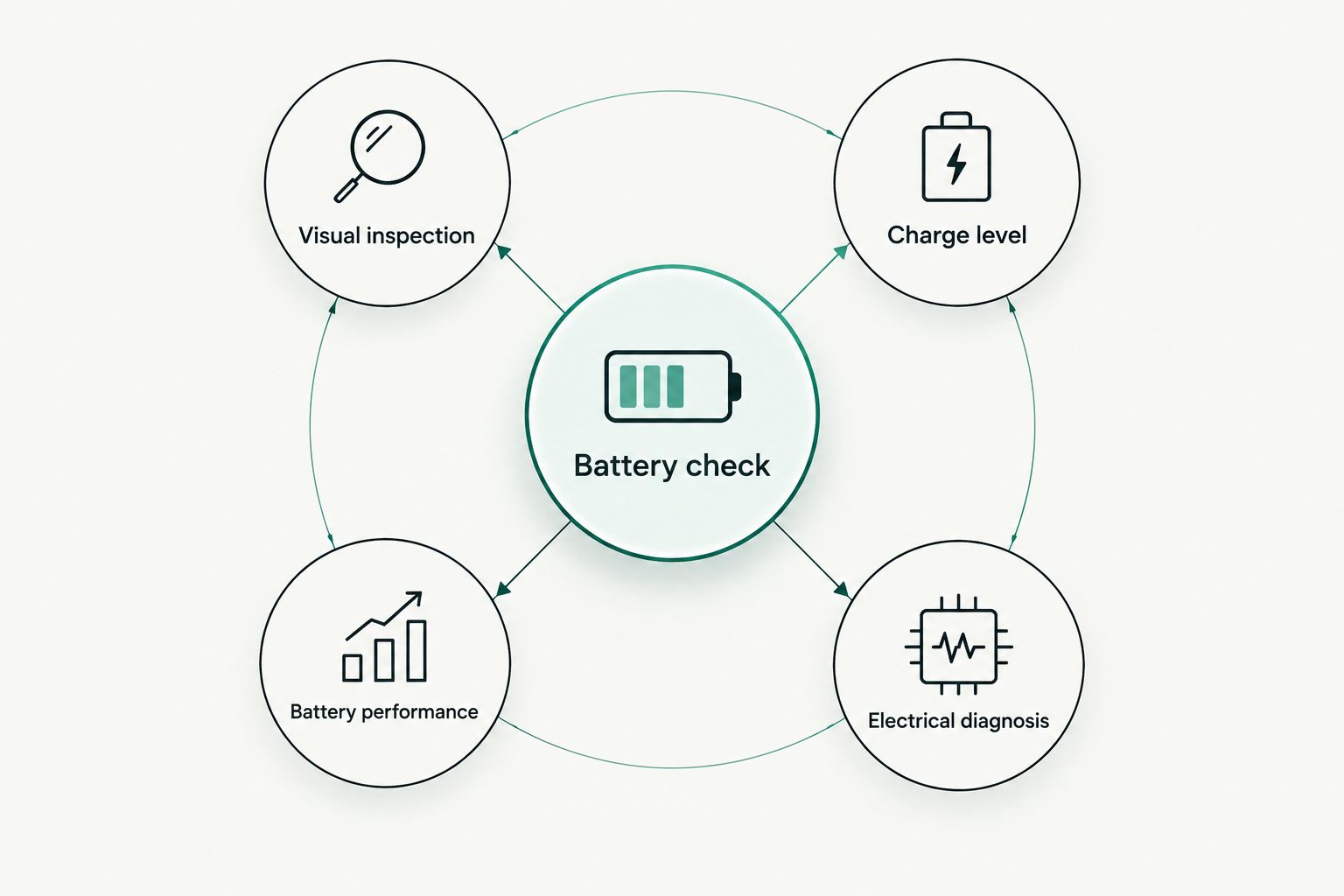
Choose the option that answers your question. A visual inspection helps identify visible hazards; a professional test addresses performance. Neither should be presented as a complete substitute for the other.
| Option | Best for | Useful advantage | Key limitation |
|---|---|---|---|
| Owner visual inspection | Spotting visible damage before further handling | Requires no battery disconnection | Cannot establish starting capability |
| Owner voltage check | Checking charge level with suitable equipment | Provides a measurable electrical reading | Does not establish battery health on its own |
| Professional battery test | Assessing battery performance before winter | Evaluates the battery against an appropriate test method | Requires correct settings and interpretation |
| Electrical diagnosis | Investigating repeated discharge or unresolved symptoms | Looks beyond the battery itself | Is a separate question from a basic battery check |
| Prepurchase inspection | Evaluating a used Honda before buying | Places battery condition within the vehicle's overall condition | Must include more than a battery result |
The practical choice for 2026 is to start with safe observation and use professional testing when you need a replacement decision. Request further diagnosis when the symptoms and battery result do not agree.
Common mistakes Tri-Cities drivers make
Treating a successful jump-start as a diagnosis
A jump-start gets power to the vehicle; it does not explain why the battery was discharged. Record what happened and arrange testing rather than assuming either that the battery is healthy or that replacement is certain.
Replacing the battery solely because winter is coming
The calendar is a reason to inspect and test, not a replacement verdict. Use the battery's condition and test findings to guide replacement, especially when the vehicle has no symptoms and the service history is clear.
Confusing a hybrid's two battery systems
A low-voltage battery assessment does not answer questions about the high-voltage propulsion battery. When shopping for a hybrid or requesting service, identify which system the report covers and ask separate questions about unresolved warnings.
Accepting a new battery as a complete used-car inspection
A new battery does not establish the condition of the brakes, tires, engine or other systems. Honda shoppers in Bristol, Johnson City and Kingsport should keep battery findings within a broader inspection rather than letting one new part settle the purchase decision.
Planning the trip without confirming the work
Explain whether you need a routine battery assessment, help with repeated discharge or a prepurchase inspection. Confirm the appointment scope before traveling; those requests involve different questions and should not be treated as identical jobs.
FAQ
When should I arrange car battery testing before winter?
Arrange car battery testing before winter temperatures expose an existing weakness, and act sooner if starting changes. Slow cranking, repeated jump-starts or visible battery damage deserve attention rather than waiting for a seasonal appointment.
Can I test my Honda battery at home?
You can inspect safely accessible areas and check voltage if you have suitable equipment and follow the owner's manual. A voltage reading alone does not establish the battery's starting capability.
Does a battery reading of 12.6 volts mean it is good?
A reading around 12.6 volts commonly indicates a fully charged conventional lead-acid battery at rest, not a complete health assessment. Battery type, temperature and recent charging affect interpretation, and performance testing answers a different question.
Should I replace my battery after one jump-start?
One jump-start does not establish that replacement is necessary. Have the battery assessed and explain the circumstances, including whether lights were left on or the vehicle sat unused.
Does a Honda hybrid battery test cover both batteries?
A low-voltage battery test does not assess the high-voltage propulsion battery. Ask which battery system the inspection covers and request model-specific guidance for any hybrid-system concerns.
What should I ask about the battery before buying a used Honda?
Ask for the installed battery's test findings, relevant service records and an explanation of any recent replacement. Include those findings in a broader prepurchase inspection rather than treating the battery as proof of overall condition.
Where is Bristol Honda for Johnson City and Kingsport drivers?
Bristol Honda is located in Bristol, Tennessee, and serves drivers from Johnson City and Kingsport. Confirm the work you need and the appointment arrangements before traveling.
One last thing
A battery can be charged without being healthy, and discharged without needing replacement. That distinction is the most useful question to carry into a service appointment or a used-Honda purchase.
Before your 2026 winter check, write down the starting symptoms, gather the service records and ask for an explanation of the result. For drivers in Bristol, Johnson City and Kingsport, the next move is the same: make the battery decision from the findings, not from a cold morning alone.