
Honda battery replacement is needed when testing confirms the battery cannot reliably supply starting power or has a defect—not simply because the car starts slowly. Slow cranking, repeated jump-starts, and electrical problems are reasons to test the battery, its connections, and the charging system. For your 2026 maintenance plan, treat these symptoms as a prompt for diagnosis rather than an automatic replacement order.
- Honda battery replacement should follow testing, not a dashboard warning or slow start alone.
- Repeated jump-starts need a battery and charging-system check; replacing the battery alone can leave the cause unresolved.
- A Honda hybrid's 12-volt battery and high-voltage traction battery require different diagnostic procedures.
- Bristol Honda serves drivers in Bristol, Johnson City, and Kingsport who need vehicle-shopping, service, or parts help.
Why this matters
A starting problem is a symptom, not a battery diagnosis. A discharged battery, loose connection, charging fault, or starter problem can produce overlapping symptoms. Buying a battery before checking the cause risks replacing a part that still works.
Bristol Honda is a local option for Honda battery replacement help for drivers in Bristol, Johnson City, and Kingsport. The dealership is located in Bristol and serves the other two cities; it does not have dealership locations in all three.
A useful battery check in 2026 should answer two questions: can the battery deliver starting power, and is the vehicle keeping it charged? Those answers guide the repair more effectively than battery age alone.
Honda battery replacement: what signs mean you need testing?
Arrange testing when your Honda cranks more slowly than usual, needs repeated jump-starts, or develops unexplained electrical interruptions. Describe exactly what happens: whether the engine turns over, whether you hear clicking, and whether the problem follows overnight parking or a period of storage.
| What you notice | What it can indicate | Useful next check |
|---|---|---|
| Slow engine cranking | Low battery charge, reduced battery capacity, or resistance at connections | Battery performance and cable inspection |
| Clicking without starting | Insufficient current, a connection problem, or a starter fault | Battery, terminals, cables, and starting circuit |
| Repeated jump-starts | A weak battery, inadequate charging, or an electrical drain | Battery and charging-system testing; drain diagnosis when indicated |
| Lights dim during a start attempt | Voltage dropping under starting load | Battery performance and connection checks |
| Battery-shaped warning light while driving | A charging-system problem | Charging-system diagnosis |
| Corrosion around terminals | A connection or battery-condition concern | Inspection of terminals, cables, and battery case |
The table identifies reasons to test, not proof that you need a replacement. For example, lights can still illuminate when a battery cannot provide enough current to start the engine. A working radio does not rule out a starting-battery problem.
Slow cranking versus normal cranking
Slow cranking means the starter turns the engine more slowly than you normally hear. That makes battery charge, battery condition, connections, and the starter circuit relevant checks.
Normal-speed cranking without the engine starting is different. Fuel, ignition, engine-control, or other faults also need consideration, so replacing the battery is not the default answer.
A warning light needs the right interpretation
The battery-shaped dashboard light generally concerns the charging system, rather than reporting battery health directly. If it stays on while the engine is running, follow your owner's manual and arrange prompt diagnosis.
Do not assume that a new battery resolves that warning. A charging fault can leave the replacement battery discharged too.
What should a Honda battery test include?
A useful diagnosis combines an inspection with electrical testing. Ask for the findings in plain language: battery condition, charge level, connection condition, and whether the charging system needs further attention.
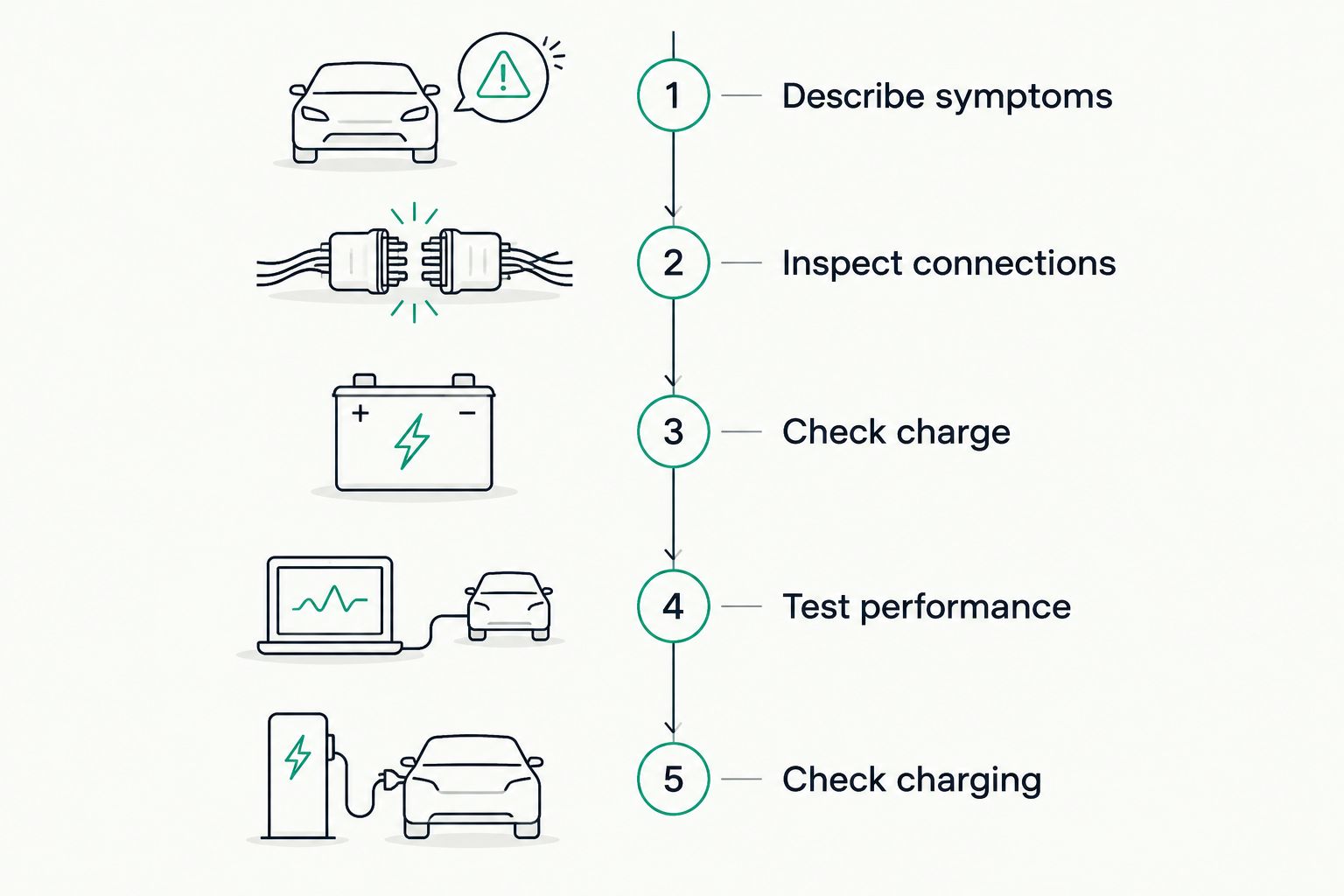
- Describe symptoms. Explain when the problem occurs, how long the car has been parked, and whether a jump-start helped.
- Inspect connections. Have the battery case, mounting, terminals, and accessible cables checked for damage or poor connections.
- Check charge. A discharged battery needs appropriate charging before some performance-test results can be interpreted correctly.
- Test performance. Use a suitable battery tester and the correct battery information to assess starting capability.
- Check charging. Investigate charging-system operation and, when symptoms justify it, unwanted electrical draw while parked.
These checks separate a battery that needs charging from one that needs replacement. They also help identify a repair elsewhere in the vehicle.
What does a voltage reading actually tell you?
A conventional, fully charged lead-acid automotive battery commonly measures about 12.6 volts at rest. A resting reading around 12.2 volts generally indicates a partially discharged battery, not an automatic replacement verdict. Temperature, battery design, recent charging, and measurement conditions affect interpretation.
A voltage reading describes charge condition more directly than starting capability. A battery can show an apparently reasonable resting voltage yet perform poorly under load, which is why a meter reading alone does not settle the diagnosis.
On many Hondas, the starting or auxiliary battery is a 12-volt battery. That name describes the electrical system category; it is not a rule that every reading must equal exactly 12 volts.
Why battery symptoms vary
Your driving pattern and the vehicle's condition affect what you notice. These factors explain why the same symptom can lead to different repairs:
- Temperature: Cold conditions reduce available battery output while increasing the effort required to crank an engine. Heat also contributes to battery deterioration over time.
- Trip length: Repeated short trips can leave less opportunity to restore energy used during starting, particularly when electrical loads are high.
- Parking periods: A parked vehicle still has electrical demands. Extended storage and abnormal electrical draw both deserve consideration when a battery repeatedly discharges.
- Connections: Corrosion, loose terminals, or damaged cables can restrict current even when the battery itself remains usable.
- Charging-system condition: A battery cannot stay charged properly if the charging system has a fault.
- Battery specification: The replacement must match the vehicle's requirements, including battery type and electrical rating—not merely fit the tray.
Tell the technician about your routine, not just the failed start. A problem after several days parked points toward a different diagnostic path than a warning light that appears while driving.
Should you replace the battery or charge it first?
Charging is appropriate when the battery is discharged but remains serviceable; replacement is appropriate when testing establishes failure. Neither choice fixes a separate charging fault or abnormal electrical drain.
| Approach | Best for | Benefit | Limitation |
|---|---|---|---|
| Charge and retest | A discharged battery without established failure | Avoids condemning a battery based only on low charge | Does not repair lost capacity or an underlying drain |
| Replace after testing | A battery confirmed defective or unable to meet requirements | Addresses the failed battery | Does not repair a charging-system or cable fault |
| Diagnose the vehicle's electrical system | Repeated discharge or charging warnings | Looks for the cause beyond the battery | Can require additional checks beyond a basic battery test |
Do not charge, jump-start, or handle a battery that is leaking, visibly swollen, or otherwise damaged. Stop and obtain professional help. Battery acid and ignition risks make a damaged battery different from an ordinary low-charge situation.
What should you check before buying a used Honda?
Make battery condition part of the purchase inspection, not a reason to accept or reject the entire vehicle on its own. In 2026, a practical shopping check still starts with service records, starting behavior, and an independent assessment of unexplained symptoms.
For a broader inspection plan, use this guide to used cars in Bristol: what to check before a test drive. Battery health belongs alongside tire condition, warning lights, braking behavior, and maintenance history.
Ask for the test result, not just a reassurance
Ask whether the battery was tested, whether it needed charging first, and whether any starting or charging concern remains unresolved. A statement that the car started successfully does not answer all those questions.
If the battery was recently replaced, ask what prompted the work. A documented failed-battery test provides different information from a replacement installed after repeated unexplained discharge.
Check the equipment before choosing a replacement
The correct battery depends on the particular vehicle. Confirm the model, engine or powertrain, required battery technology, physical fit, terminal arrangement, and electrical rating through the owner's information or a qualified parts professional.
Do not substitute a different battery technology simply because its dimensions look right. Vehicles with specific electrical requirements need a compatible replacement and the appropriate installation procedure.
Consider ownership needs as well as the test drive
A shopper in Bristol, Johnson City, or Kingsport should ask the same practical question: what maintenance does this particular vehicle need after purchase? Separate a documented battery issue from unrelated decisions about cabin space, powertrain, or vehicle condition.
That keeps a straightforward repair from distracting you from the larger purchase. It also prevents a recently installed battery from becoming a substitute for a proper vehicle inspection.
What should you bring to a battery service visit?
Bring the vehicle details, any relevant service paperwork, and a description of the symptoms. When discussing Honda battery replacement with Bristol Honda, explain whether you own the vehicle already or are evaluating one for purchase.
Useful details include:
- Whether the engine cranks slowly, cranks normally, or does not crank.
- Whether warning lights stay on after the engine starts.
- Whether the problem follows overnight parking, storage, or short trips.
- Whether a jump-start helped and whether the symptom returned.
- Any recent battery installation, electrical repair, or accessory installation.
For a 2026 service visit, request an explanation of the test findings and the proposed next step before authorizing replacement. Ask whether the battery needs charging, replacement, or further electrical diagnosis.
If you are shopping instead, ask how an identified concern will be documented and addressed. Do not treat a verbal assurance about a battery as a substitute for understanding the vehicle's overall condition.
Does a Honda hybrid need a different battery check?
A Honda hybrid has a low-voltage electrical system as well as a high-voltage traction-battery system. A problem involving the 12-volt battery is not the same diagnosis as a traction-battery fault.
Tell the service team which warnings appear and whether the vehicle enters its normal ready-to-drive state. Do not handle high-voltage components or apply conventional battery-testing procedures to them; follow model-specific guidance and use qualified service personnel.
FAQ
How do I know if my Honda needs battery replacement?
Your Honda needs battery replacement when testing confirms the battery is defective or cannot meet the vehicle's requirements. Slow cranking and repeated jump-starts justify testing, but connections and charging faults can produce similar symptoms.
Can my Honda battery be bad if the lights still work?
Yes, a battery can power lights yet fail to deliver enough current to start the engine. A suitable performance test helps distinguish battery failure from connection or starter-circuit problems.
Does a battery warning light mean I need a new battery?
No, a battery-shaped warning light generally indicates a charging-system concern rather than directly measuring battery health. Follow the owner's manual and arrange diagnosis instead of assuming replacement will clear the fault.
Should I replace my Honda battery after a jump-start?
A jump-start alone does not establish that your Honda battery needs replacement. Have the battery tested and investigate why it discharged, especially if the problem returns.
What voltage should a Honda battery show when the engine is off?
About 12.6 volts at rest is common for a fully charged conventional lead-acid automotive battery. Battery design, temperature, and recent charging affect the reading, and voltage alone does not establish starting capability.
Is a Honda hybrid battery the same as its 12-volt battery?
No, a Honda hybrid's high-voltage traction battery and 12-volt auxiliary battery have different functions and diagnostic procedures. Identify the warning or starting symptom before assuming which battery needs attention.
Can Bristol Honda help drivers from Johnson City and Kingsport?
Bristol Honda is located in Bristol, Tennessee, and serves drivers from Johnson City and Kingsport with vehicle sales, financing, service, and parts. Describe your starting symptoms when asking about battery-service next steps.
One last thing
A successful jump-start proves that extra electrical power helped—not that the battery was the only problem. Before buying a replacement, ask what caused the discharge and what the test established.
Make that question part of your 2026 maintenance routine. It works equally well when caring for your current Honda or checking a vehicle before purchase.