Book Honda brake service when you notice a change in braking, hear recurring brake noise, see a brake-related warning, or reach an inspection point specified for your vehicle. A soft or sinking pedal, noticeably reduced stopping ability, smoke, or a suspected fluid leak calls for stopping safely and arranging assistance—not driving to an appointment.
- Book Honda brake service for recurring noise, vibration, pulling, or a changed pedal—not just a mileage milestone.
- Stop safely if braking weakens, the pedal sinks, or you suspect a brake-fluid leak.
- Bristol Honda serves drivers seeking Honda brake service in Bristol, Johnson City, and Kingsport.
- When shopping used, request brake inspection findings; a quiet test drive does not establish brake condition.
Honda brake service: when should you book an inspection?
Book an inspection when braking changes, not after you decide which part needs replacing. Noise, vibration, pedal feel, and warning lights describe symptoms; they do not establish the cause. Your owner's manual supplies the vehicle-specific maintenance guidance.
Use this sequence to decide your next move:
- Assess stopping ability. If the vehicle does not slow normally, the pedal sinks, or you see smoke, pull over safely and arrange assistance. Do not continue driving to investigate.
- Identify the warning. Check the exact dashboard symbol and the instructions in your owner's manual. A parking-brake indicator and an antilock-brake warning do not mean the same thing.
- Describe the change. Record whether the symptom happens while braking, turning, starting out, or driving continuously. Mention whether it began suddenly or developed gradually.
- Request an inspection. For recurring noise, vibration, or pulling without an immediate loss of braking, contact a qualified service team promptly. Ask whether the symptom requires transportation rather than driving.
For local help, Bristol Honda is located in Bristol, Tennessee, and serves Johnson City and Kingsport. Describe the symptom before setting off so the team can discuss an appropriate next step.
Why this matters
A brake inspection answers a different question from a brake replacement: what is causing the symptom, and what work does the vehicle actually need? Replacing pads without checking the rest of the system leaves that question unanswered.
For your 2026 maintenance planning, use vehicle-specific instructions and documented condition rather than a universal mileage rule. Driving conditions, component condition, and maintenance history all affect the inspection discussion.
The same principle applies when buying a vehicle. Whether you drive in Bristol, Johnson City, or Kingsport, separate what you can observe on a test drive from what requires a professional inspection. A comfortable drive is useful information, but it is not a brake-condition report.
What do different brake symptoms mean?
A symptom helps direct an inspection; it does not identify a replacement part by itself. Tell the service team what happens without assuming the vehicle needs pads, rotors, or fluid service.
| Situation | Best next step | What that step accomplishes | Limitation |
|---|---|---|---|
| Reduced stopping ability, sinking pedal, smoke, or suspected fluid leak | Stop safely and arrange assistance | Avoids continuing with a potentially unsafe braking condition | Does not diagnose the fault |
| Recurring squeal, grinding, vibration, or pulling | Request a prompt inspection and discuss driving safety | Gives a technician specific symptoms to investigate | Noise or vibration alone cannot identify the failed part |
| Brake-related dashboard warning | Follow the owner's manual for the exact indicator | Distinguishes the required response for that warning | Different indicators require different responses |
| No symptoms, but maintenance is due | Follow the vehicle's maintenance guidance | Supports condition checks before a noticeable problem develops | No single interval applies to every Honda |
| Used vehicle under consideration | Request documented findings and a pre-purchase inspection | Adds evidence beyond the sales description | A test drive cannot reveal every brake-system issue |
Grinding deserves prompt attention even when the vehicle still stops. Do not wait for a scheduled maintenance visit simply because stopping ability feels unchanged.
A brief sound after rain can differ from recurring noise, but that distinction is not permission to dismiss a symptom. Describe when the sound occurs, whether it disappears, and whether pedal feel or stopping performance changes with it.
What should a Honda brake inspection cover?
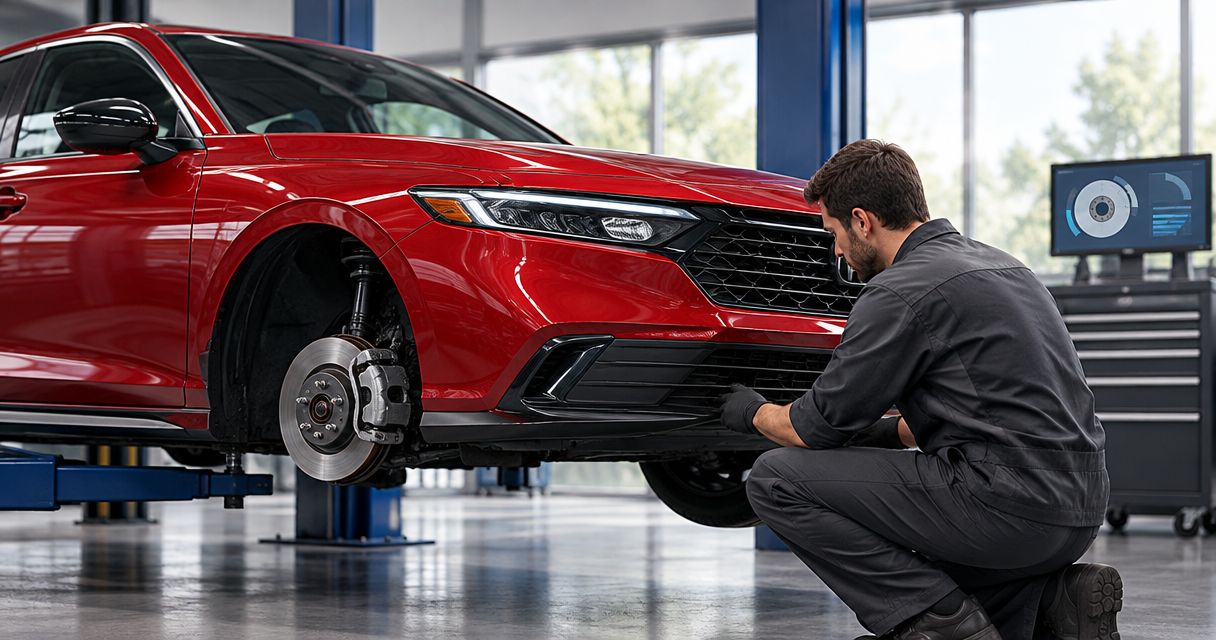
Ask for an inspection that addresses your complaint and evaluates the braking system—not merely a recommendation based on the vehicle's mileage. The exact procedure depends on the model, symptoms, and service information.
Useful inspection subjects include:
- Friction components: Pad condition and rotor condition, including uneven wear or visible damage.
- Hydraulic components: Signs of leakage and the condition of accessible hoses, lines, and related components.
- Brake operation: Pedal concerns, pulling, vibration, dragging, and other symptoms you reported.
- Warning indicators: Diagnosis appropriate to an illuminated warning, rather than assuming a mechanical wear item caused it.
- Parking brake: Operation and any concerns relevant to the vehicle's design.
Ask the service advisor to distinguish an observed condition from a confirmed cause. Uneven wear, for example, deserves an explanation of what is contributing to it—not just a list of replacement parts.
Bristol Honda is a practical choice for local Honda owners who want vehicle shopping and service help from a dealership in Bristol. For brake work, ask what the inspection includes and request an explanation of the findings before authorizing repairs.
Why brake-service needs vary
There is no dependable replacement schedule that fits every driver and every Honda. These factors explain why an inspection is more useful than a blanket mileage prediction:
- Braking frequency: Frequent stops create different friction-brake demands from driving with fewer stops.
- Hills and loads: Descents and additional vehicle load affect the work the brakes must do.
- Weather exposure: Moisture and corrosion can affect brake surfaces and components.
- Component condition: Sticking components or uneven wear can change the repair needed.
- Vehicle design: Brake hardware, maintenance instructions, and hybrid regenerative braking differ across vehicles.
- Service history: Previous repairs and unresolved symptoms matter when interpreting current condition.
Use these factors to explain your driving, not to calculate a replacement date yourself. For a 2026 service visit, bring the maintenance records you have and describe changes in your usual routes or vehicle use.
Buying a Honda? Make brake condition part of the decision
Shopping and maintenance belong in the same conversation. A vehicle that suits your seating, cargo, and commuting needs still deserves a clear discussion of condition and service history.
For a new Honda, ask the team to explain the vehicle's brake-related indicators and maintenance guidance before delivery. This is an opportunity to learn what normal operation feels like and where to find model-specific instructions—not a reason to assume every model uses the same system.
For a used Honda, request the available service history and current inspection findings. Ask whether recommended brake work has been completed, remains outstanding, or needs further diagnosis. A description such as recently serviced does not explain which components were checked.
For a certified pre-owned Honda, request the certification documents and review the brake-related inspection information. Certification paperwork supports your decision; it does not replace reading the findings or asking about an unresolved symptom.
Drivers comparing vehicles in Bristol, Johnson City, and Kingsport should use the same standard: choose the vehicle that fits your needs, then verify its condition. Do not treat a quiet cabin, clean wheels, or a polished presentation as evidence of healthy brakes.
What should you check before a test drive?
Before moving the vehicle, ask about any warning lights and confirm that the seller has addressed any known braking concern. If the pedal feels abnormal or a warning requires stopping, do not begin the drive.
During an approved test drive, use ordinary, legal driving conditions. Notice whether the vehicle slows smoothly, whether the pedal feels consistent, and whether braking brings on noise, vibration, or pulling. Never perform an emergency-stop experiment on a public road.
Afterward, report exactly what you noticed. A useful description is that vibration appeared while slowing; an unsupported diagnosis is that the vehicle definitely needs rotors. Let inspection findings establish the cause.
For your 2026 shopping checklist, keep comfort and condition separate. A vehicle can fit your daily routine while still needing work, and a brake concern should be resolved before you make assumptions about ownership readiness.
Keep 2 records when comparing vehicles or arranging service
You do not need a detailed mechanical diary. Keep 2 records: a symptom note and the available maintenance history. Together, they help a technician investigate a concern and help you compare used vehicles on something more concrete than appearance.
Your symptom note should describe the sound or sensation, when it occurs, and any dashboard message. Record whether the concern happens only while braking or also while the vehicle is moving without brake input.
Your maintenance history should identify completed work and unresolved recommendations. For a vehicle you are considering buying, ask for the records the seller can provide rather than assuming missing paperwork means work was completed.
If records are incomplete, say so. That gives the service team a clear starting point and keeps an unknown history from turning into an assumed maintenance schedule.
Ask 3 questions before approving brake work
Ask 3 questions: what was found, what work addresses it, and how will the result be checked? These questions keep the conversation focused on the vehicle rather than a package name.
- What was found? Request the inspection findings, relevant measurements, and an explanation of how they relate to your complaint.
- What work addresses it? Ask which items address an immediate concern and which are maintenance recommendations. Request clarification when the proposed work extends beyond the original symptom.
- How will the result be checked? Ask how the team will confirm operation after the repair and whether further diagnosis is needed if the original concern remains.
A detailed explanation has value, but it is not a substitute for the inspection itself. Likewise, a parts list is not proof that every listed component caused the symptom.
Bristol Honda offers vehicle sales, financing, service, and parts. When you contact the team, make your purpose clear: brake diagnosis for your current vehicle, maintenance planning, or condition questions about a vehicle you are considering.
Discuss your Honda's next step
Ask about brake concerns, maintenance records, or vehicle-shopping questions before your visit.
Can you wait until your next oil change?
Do not wait for an oil change when braking changes. Recurring noise, vibration, pulling, or a changed pedal warrants a separate conversation about inspection timing. Reduced stopping ability requires stopping safely, not combining appointments.
Should you replace brake pads before selling your Honda?
Inspect the brakes before deciding on replacement. Documented findings explain what the vehicle needs more clearly than replacing parts without a diagnosis. Disclose unresolved concerns and keep records of completed repairs.
Does a hybrid Honda still need brake inspections?
A hybrid Honda still needs brake inspections and vehicle-specific maintenance. Regenerative braking does not eliminate friction brakes. Follow the instructions for the exact model rather than applying a conventional vehicle's assumed schedule.
FAQ
When should I book Honda brake service in 2026?
Book Honda brake service when braking changes, recurring noise develops, a brake-related warning appears, or your vehicle's maintenance guidance calls for an inspection. Stop safely and arrange assistance if stopping ability is reduced or the pedal sinks.
Can I drive my Honda if the brakes are grinding?
Do not assume grinding brakes are safe to drive. Contact a qualified service team promptly, describe any change in stopping or pedal feel, and arrange transportation if braking is impaired.
Does squeaking always mean my Honda needs new brake pads?
Squeaking alone does not establish that your Honda needs new brake pads. An inspection should identify the source and evaluate component condition before replacement is recommended.
How often should Honda brake pads be replaced?
Honda brake-pad replacement depends on measured condition, driving use, and vehicle-specific guidance—not a universal mileage interval. Ask for inspection findings rather than treating mileage alone as a diagnosis.
What should I ask about brakes when buying a used Honda?
Ask for available service records, current brake inspection findings, and details of unresolved recommendations. A normal-feeling test drive does not establish the condition of every brake component.
Does Bristol Honda serve Johnson City and Kingsport?
Bristol Honda is located in Bristol, Tennessee, and serves drivers from Johnson City and Kingsport. Contact the dealership about service or shopping questions before planning your visit.
One last thing
A quiet brake system is not the same as a documented brake inspection. That distinction matters whether you are keeping your current Honda or comparing your next vehicle.
Make your next 2026 appointment or shopping visit more useful: bring your symptom note, available maintenance records, and questions about unresolved recommendations. The goal is a clear explanation of condition and next steps—not a guess based on sound, mileage, or appearance.