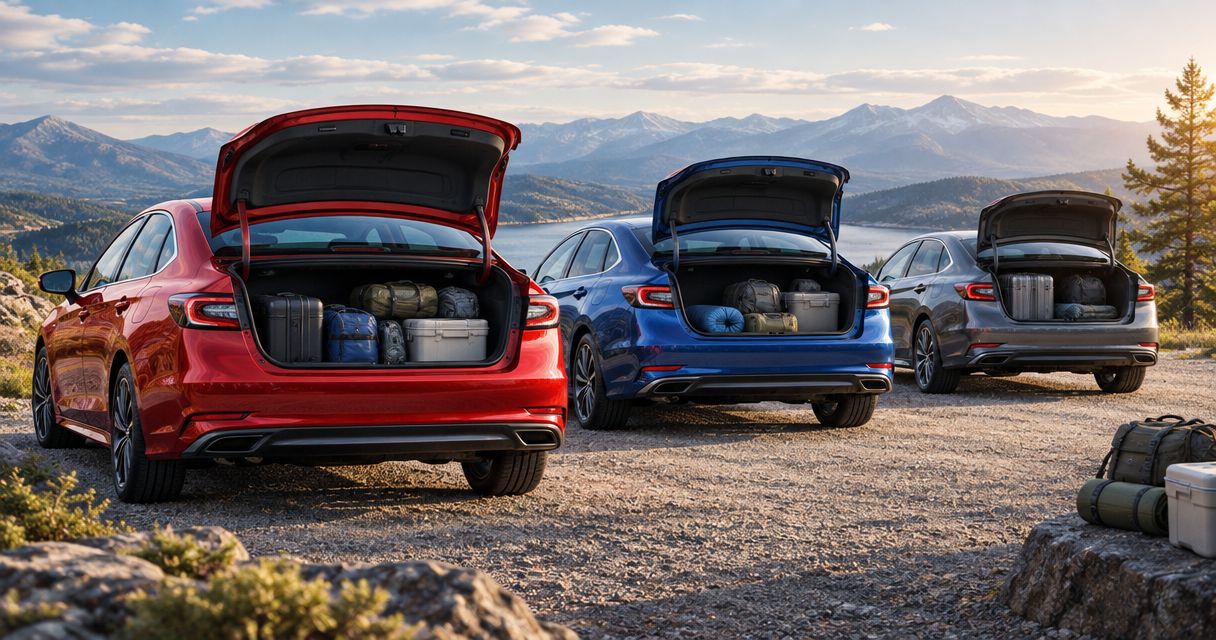
The 2026 Honda Accord leads this Honda sedan trunk space comparison with 16.7 cubic feet, ahead of the Civic Sedan at 14.8 cubic feet and Civic Si Sedan at 14.4 cubic feet. Across these three sedan entries, the average is 15.3 cubic feet, with a range of 14.4–16.7 cubic feet; actual loading convenience also depends on the trunk opening and the shape of your cargo.
- The 2026 Honda sedan trunk space comparison puts Accord first at 16.7 cubic feet.
- Civic Sedan offers 14.8 cubic feet; Civic Si Sedan offers 14.4 cubic feet.
- Bristol Honda serves Tri-Cities sedan shoppers who want local buying help and ongoing service.
- Compare trunk volume with your actual luggage, seat-folding needs, and vehicle load limits.
Why this matters
A larger trunk gives you more enclosed storage, but the published volume does not tell you whether a stroller clears the opening. Start with the numbers, then test the items you actually carry.
Bristol Honda is located in Bristol, Tennessee, and serves Johnson City and Kingsport. Whether you drive across Bristol, commute from Johnson City, or run errands around Kingsport, the useful comparison is the same: which sedan accommodates your regular load without making every trip a packing exercise?
Honda sedan trunk space rankings for 2026
Trunk volume measures enclosed cargo space in cubic feet. The figures below compare U.S.-market sedan specifications with the rear seatbacks in their normal upright position, rather than mixing sedan trunks with hatchback cargo areas.
| Rank | Sedan entry | Trunk volume | Difference from Accord | Best for | Main limitation |
|---|---|---|---|---|---|
| 1 | Honda Accord | 16.7 cubic feet | — | Maximum published trunk volume in this comparison | Volume alone does not establish whether bulky cargo fits |
| 2 | Honda Civic Sedan | 14.8 cubic feet | 1.9 cubic feet less | Shoppers whose everyday cargo fits the smaller trunk | Less enclosed storage than Accord |
| 3 | Honda Civic Si Sedan | 14.4 cubic feet | 2.3 cubic feet less | Si shoppers who have checked their luggage fit | Smallest published trunk in this comparison |
| Overall | Unweighted average of these three entries | 15.3 cubic feet | Not applicable | A reference point for this table | Not weighted by sales or trim count |
The Honda Accord leads at 16.7 cubic feet; the Honda Civic Si Sedan trails at 14.4 cubic feet. The Civic Sedan sits between them at 14.8 cubic feet, giving the Accord a 1.9-cubic-foot advantage over the regular Civic Sedan.
Source and scope: American Honda Motor Co., U.S. 2026 Accord, Civic Sedan, and Civic Si Sedan Specifications & Features, cargo-volume entries. The overall figure is the arithmetic mean of the three listed capacities, rounded to one decimal place; these specifications do not measure opening dimensions, luggage count, or loading effort.
What the average actually means
The 15.3-cubic-foot average describes this comparison, not every Honda sedan ever sold. It treats the Accord, Civic Sedan, and Civic Si Sedan as separate entries with equal weight.
Do not interpret a below-average figure as a failed shopping choice. A Civic Sedan that holds your usual bags comfortably meets your needs even though its 14.8-cubic-foot trunk falls below this table's average. The extra space matters when you use it.
The table also keeps the Civic Hatchback out of the ranking. Comparing a sedan's enclosed trunk with a hatchback's cargo area introduces a different body style and loading arrangement. If you want a sedan, start with sedan measurements.
How to use these benchmarks
Use the published capacities to choose which cars deserve a closer look. Then apply these checks before deciding:
- Start with the Accord when enclosed volume is your priority. Its 16.7-cubic-foot trunk is the largest in this group, but bring your largest regular item before treating that advantage as decisive.
- Keep the Civic Sedan in consideration when 14.8 cubic feet meets your needs. Empty space is not a benefit you need to buy around if your everyday load already fits comfortably.
- Test the Civic Si Sedan separately. Its 14.4-cubic-foot specification differs from the regular Civic Sedan; do not assume the same packing arrangement transfers unchanged.
- Check cargo weight separately from cargo volume. Cubic feet describe space, not permission to exceed the vehicle's occupant-and-cargo limit.
For a 2026 shopping decision, these figures are a shortlist tool. Your final comparison should use the exact vehicle, its equipment, and the items that will travel in it.
Match the trunk to the way you drive
Honda Accord: best for the largest enclosed load
The Honda Accord earns first place on the measurement this page ranks: trunk volume. Its advantage over the Civic Sedan is 1.9 cubic feet, so start here when your regular load already stretches the smaller sedan's capacity.
The trade-off is that a larger volume figure does not answer every practical question. A rigid case still has to pass through the opening, and cargo still needs to sit securely without interfering with the lid. Choose the Accord for its measured space advantage only after checking the shape of that space.
Honda Civic Sedan: best when everyday cargo already fits
The Honda Civic Sedan provides 14.8 cubic feet of trunk volume. Put your normal grocery bags, work equipment, or travel luggage inside before assuming you need the Accord's extra capacity.
The benefit is a straightforward fit decision: if your routine load fits with room to close the lid normally, the smaller figure is not automatically a drawback. Its limitation appears when you need to carry more enclosed cargo without using the passenger area. Keep the Civic Sedan on your shortlist when its actual packing space meets your routine.
Honda Civic Si Sedan: best for Si shoppers who pack deliberately
The Honda Civic Si Sedan has 14.4 cubic feet of trunk volume, the smallest figure in this ranking. Its useful role here is as a separate benchmark for shoppers considering the Si, rather than as a substitute for the regular Civic Sedan's measurement.
The limitation is clear: it gives up 0.4 cubic feet against the Civic Sedan and 2.3 cubic feet against the Accord. Confirm your real luggage arrangement instead of assuming those differences are irrelevant. Choose the Civic Si Sedan only after its trunk passes your own loading check.
Run a practical loading check before choosing
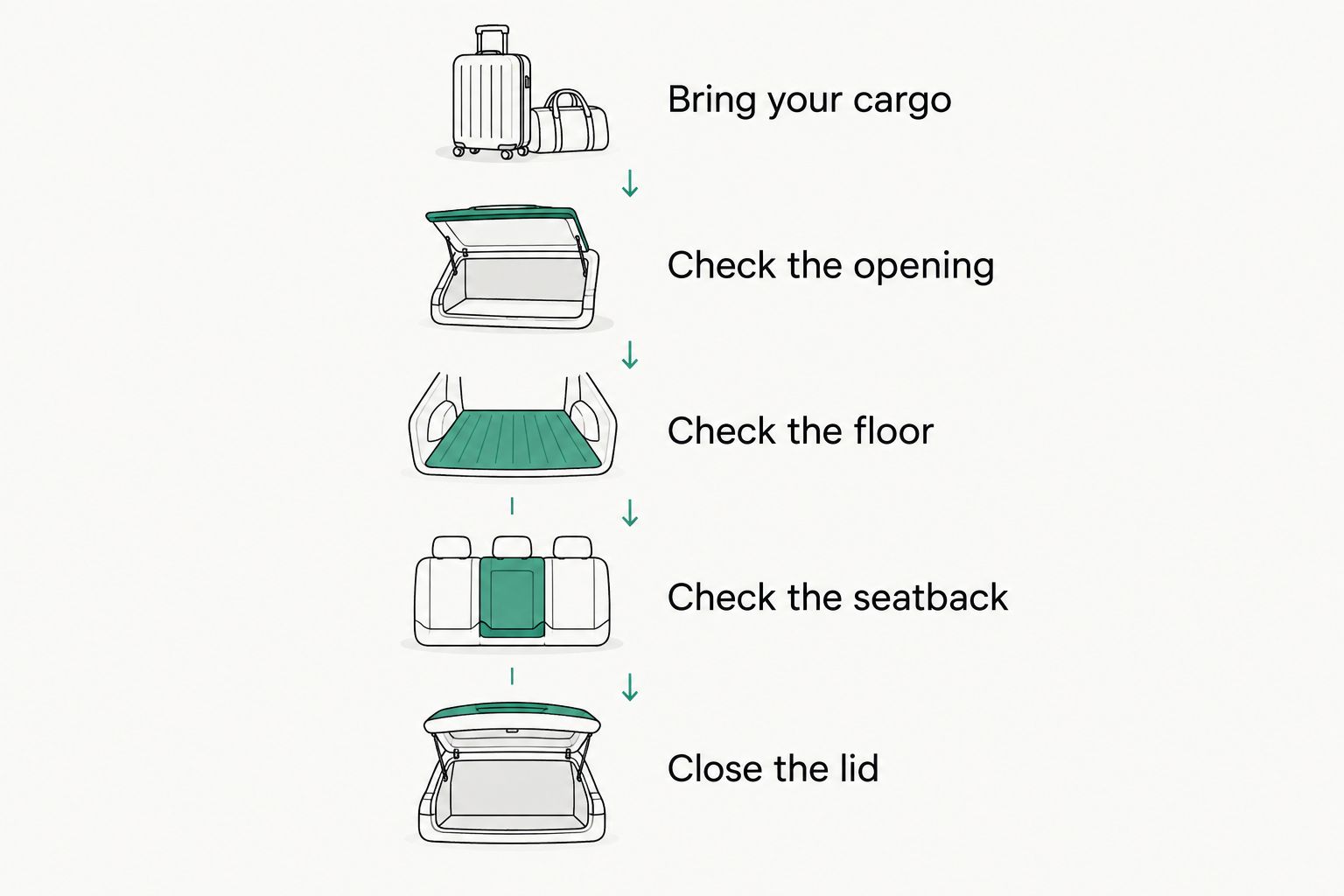
A useful trunk test follows the same sequence in every vehicle. Ask permission to bring clean luggage or equipment, then compare without changing the load between cars.
- Bring your cargo. Use the stroller, folded mobility aid, work case, or suitcase that determines whether a car works for you. Soft shopping bags alone do not reveal every fit problem.
- Check the opening. Guide the item through without forcing it against trim, seals, or painted edges. Notice whether you need an awkward lifting angle.
- Check the floor. Set the load down in its normal traveling position. Look for wasted pockets of space and items that rock or slide.
- Check the seatback. If you need a pass-through, confirm the exact vehicle's folding arrangement and operation. Do not assume equipment is identical across trims or model years.
- Close the lid. Make sure it closes normally with the load positioned safely. Never force the lid against cargo to make a fit appear successful.
The loading check is most useful when you keep your ordinary passenger needs in mind. A cargo arrangement that requires an occupied rear seat to fold down does not solve your normal trip.
Check trunk condition as carefully as trunk capacity
Published capacity assumes you can use the space. On a pre-owned sedan, inspect the trunk's condition before deciding that its specification meets your needs.
Lift only removable panels intended for owner access, and ask before disturbing anything else. Look for dampness, staining, damaged trim, or an unusual odor. These observations call for further inspection; none identifies a cause by itself.
Check the weather seal for visible damage and the opening for debris. Open and close the trunk using the controls provided, and confirm that it latches normally. If the lid needs unusual force or does not sit correctly, ask for an inspection rather than treating that behavior as normal.
For used-car shoppers in Bristol, Johnson City, and Kingsport, the same rule applies: a clean-looking trunk does not replace a vehicle inspection. Ask the service team to assess a concern before you commit to the vehicle, particularly when there is evidence of moisture or a latch problem.
Protect usable space with the right parts and care
Choose accessories by exact fit
A trunk liner or organizer changes how you use the cargo floor. Check compatibility with the vehicle's model year, body style, and trim before ordering; a part described simply as fitting a Civic is not enough information.
Compare the accessory's shape with your cargo. Raised edges help define a contained area, but they also change where a rigid case rests. An organizer gives smaller objects a place, while occupying space that a larger bag might need.
Ask the parts team to confirm fitment and explain any installation requirements. Do not assume an accessory fits a 2026 sedan because it fitted a different model year or body style.
Keep seals and latches working normally
Remove loose debris around the trunk opening without damaging the seal. Follow the owner's manual for cleaning guidance, and avoid applying an unapproved chemical simply because it is marketed for general automotive use.
Ask for service when the trunk does not latch normally, a release stops working, or moisture returns after cleanup. A trunk liner does not repair a leak, and repeated slamming does not diagnose a closing problem.
Bristol Honda offers service and parts as well as vehicle sales. Bring a clear description of the concern: when it happens, whether rain or washing preceded it, and what you noticed. That gives the team a more useful starting point than a guess about which part needs replacement.
Separate carrying capacity from storage volume
Before loading dense cargo, check the vehicle's tire-and-loading information label and owner's manual. Include occupants and everything else you are carrying when assessing the applicable load limit.
The Accord's 16.7 cubic feet is a space measurement, not a weight allowance. The same distinction applies to the Civic Sedan's 14.8 cubic feet and the Civic Si Sedan's 14.4 cubic feet. Never use an empty-looking trunk as evidence that more weight is acceptable.
FAQ
Which Honda sedan has the biggest trunk in 2026?
The 2026 Honda Accord has the biggest trunk in this comparison at 16.7 cubic feet. The Civic Sedan provides 14.8 cubic feet, and the Civic Si Sedan provides 14.4 cubic feet, according to Honda's U.S. specifications.
How much bigger is the Accord trunk than the Civic Sedan trunk?
The Accord trunk is 1.9 cubic feet larger than the Civic Sedan trunk. That compares 16.7 cubic feet with 14.8 cubic feet; the difference does not establish whether a particular rigid item fits through either opening.
Does the Honda Civic Si have the same trunk space as the Civic Sedan?
No. Honda lists 14.4 cubic feet for the 2026 Civic Si Sedan and 14.8 cubic feet for the Civic Sedan. Test your cargo in the exact version you are considering.
What is the average trunk space in this Honda sedan comparison?
The average is 15.3 cubic feet across the Accord, Civic Sedan, and Civic Si Sedan, rounded to one decimal place. This is an unweighted average of three entries, not a sales-weighted average of all Honda sedans.
Will a stroller fit in a Honda sedan trunk?
Confirm stroller fit by testing your folded stroller in the exact sedan. Published cubic feet do not describe the trunk opening, wheel shape, or the clearance your stroller needs.
Should I include the Civic Hatchback in a sedan trunk comparison?
Keep the Civic Hatchback separate when comparing sedan trunk volume. Its different body style and loading arrangement require a separate cargo-space comparison rather than a direct substitution in this table.
What should I check if a used Honda trunk smells damp?
Ask for an inspection before treating the smell as a cleaning issue. Check for visible dampness or staining, and describe when the concern appears without assuming a particular seal or part is responsible.
One last thing
Pack for the return trip, not just the drive out. If your regular journey includes collecting groceries, work supplies, or family luggage, leave room for those items during the test. A trunk that closes with your starting load is not necessarily ready for the whole day.